Showing posts with label fascism. Show all posts
Showing posts with label fascism. Show all posts
Sunday, August 25, 2019


Friday, October 7, 2016
Wednesday, February 19, 2014
Sunday, February 16, 2014
Friday, March 8, 2013
von der oberseite des reichstag

In ihrem gemeinsamen Mund
lebt ein "Kolibri"!

Mit jedem seiner Flügelschläge
dafür das Auge viel zu träge
Kulturen erblühen und vergehen
ganze Kontinente untergehen
Hier gibt es keine harmlosen Worte
alle viel zu gross . . . .

Wärend nur eines Augenaufschlags
haben sie geputscht!
die Regierung gestürzt
Parlament aufgelöst
haben Wahlen abgehalten
das Ergebnis annulliert

haben Wahlen wiederholt
sind letztendlich exiliert
von Geschichte ausradiert
Ich durch den Dreck bedeutender
Metaphern

Meta, Meta. Meta für Meter
mit Gesten viel zu breit
für die Imterimsliebenden
~ Blixa Bargeld, 1992
Wednesday, April 25, 2012
ode to torture porn
"Torture porn" is a derogatory term recently in vogue for describing the genre of cinema which is exploitative and centers upon the graphic depiction of torture.
What is the appeal of such a genre? Why would anyone, presumably with enjoyment, watch a movie valued (solely) for its depiction of torture?
The answer is the human condition.
Torture porn is rightly compared to porn, for both are instance of "exploitation" cinema, where exploitation here is characterized by a value measured solely in the depiction of some particular subject, not by more abstract measures of cinematic value (story, acting, dialog, etc.).
Shakespeare, for example, is the sheer antithesis of "exploitation" in this sense precisely because, even during his most ludicrous comedies, bloody tragedies, or ass-kissing historical plays, the value of the play (as we cherish it today) does not depend upon the depiction of farcical situations / violence / fawning political commentary, but upon the clever dialog and subtle characterization.
Porn is the most famous exploitation genre, exploiting the act of sex, but it depends no less single-mindedly upon the mere depiction of sex than, say, martial arts movies depend upon the depiction of a certain style of violence, westerns on a certain setting and aesthetic, horror upon creation of a certain type of suspense, etc.
So, "torture porn" is justly named, it is indeed the valuing of the mere depiction of violent acts of torture against other human beings over and above plot / dialog / characterization / production value / etc.
But why? What is the appeal, and, empirically, given its existence as a profitable genre for decades, there is appeal, of torture porn? What drives people to watch it? In what sense do they enjoy it?
Here, a compelling answer is found in the culture which is perhaps the greatest consumer (and producer) of torture porn: Japan. The 1976 film Shogun's Sadism, also called The Joy of Torture 2: Oxen Split Torturing begins with this quote:
'The weak become the victim of the strong,' is a rule of mankind. Cruelties have been inflicted everywhere since time began.
How true this observation is! But let us be careful. Let us not be swayed by utopian dreams of an equal society, where every individual is equivalent in power to another and there are no "weak" and "strong." Politically, such a situation has never been realized. Even attempts (one thinks: Soviet Union, North Korea, China, Cuba) to establish a communal society universally fail. No matter what, strong and weak separate, communities organize themselves into a hierarchy on the basis of power.
This is no less true at smaller or larger scales. Just as nations economically bully each other into engaging in particular international policies, so smaller groups (a class in elementary school, a university department, a band, a pair of lovers) inevitably establish structures of power, control, and thus hierarchy. Of course, at smaller scales, there is much more room for give and take, for the possibility of some kind of equivalence, even if it is only represented by a regular alteration in the relative positions of power.
As Baudelaire observed:
[L]ove is very like a torture or a surgical operation. But this idea can still be more bitterly expressed. Even though a pair of lovers may be deeply devoted, full of mutual desires, one of them will always be calmer, or less obsessed, than the other. He or she must be the surgeon or torturer; the other the patient or victim.
No accident that he characterized love as a "[d]readful game, in which one of the players must lose his or her self-government," for "government" in every sense is a position of power, of control. And the inherently hierarchical structure of human interactions necessitates the abandonment of (self-)government.
Torture is the purest realization of that aspect of love which mirrors the general structure of society as a whole; the necessary preconditions of the organized interaction amongst those who, without interaction, would otherwise be equals.
So, the existence of torture is the fundamental precondition for human society.
(Surely, this has already been remarked upon by Bataille?)
But this does not explain the appeal of "torture porn" the movie genre. For if it is indeed a precondition of social interaction, if it does indeed permeate every moment of our human existence, what pleasure then is to be derived from the single-minded fictional depiction of torture? What pleasure derived from the externalization, the graphical and physiological depiction, of an inherently internal and counterfactual social dynamic. "Torture porn" makes that which exists at the level of possibility, of control, of what can be achieved, visible, visceral, and ineluctable.
Here, the crucial answer is to be found in the attitude of the cinema goer to his or her positions within the many overlapping social hierarchies in which she / he participates.
Those who are resigned to their position or those who are satisfied with it, will not enjoy "torture porn."
"Torture porn" is a genre of the disenfranchised, the dissatisfied, those who desire a change (a radical, violent change) in social position. Furthermore, this desire for change must be intimately intertwined with some (subconscious? / conscious?) understanding of their social standing and a realization (even mere gut "grasping") of the relationship between their state of mind (happiness, or lack thereof, etc.) and their position within this social hierarchy.
And here, the ostensibly value-neutral flavor of this essay must end.
For, desiring a position of greater power precisely so that one might wield that power is surely morally reprehensible. To wish to dominate in principle, so one might also dominate in practice, is to succumb to sadism, evil, and the very corrupting influences of power which motivate the drive towards equality as a regulative ideal in the first place.
So, yes, the lover of torture porn may be evil.
(A Japanese example, one picked at random amongst many: Tsutomu Miyazaki.)
But this is not the only human drive which might motivate an "enjoyment" of "torture porn." And this precisely is the point, and why "torture porn" as a derogatory term is indeed unjustified, why the assumption that those who do "enjoy" it are necessarily monsters is, in fact, the true position of evil. The position assumed by the sadist, the torturer, the pervert.
For the desire to be a part of hierarchical change may be motivated not by inherent cruelty, but by pain, victimization, the realization that the lack of power one holds over one's life, that impotence, is an unfair and undesirable state. One might identify in torture porn not with the torturer, but the torturee. And not out of some misplaced (masochistic) sexual dynamic, but out of pure empathy.
For we all are tortured in this life, and to see a graphic analogical depiction of the that very whimsical "torture" to which we are every moment subject may have a profound power of catharsis.
Thus, so-called "torture porn" may be a positive force for healing, for self-realization, for release, understanding, acceptance, but also a constructive release of tension.
And this is why the critiques of Mel Gibson's Passion as mere "torture porn" are so ignorant and woefully misplaced. For this is indeed the role that the story of the passion of Christ as a mythology has always played—a role of catharsis for those subjugated by the (inevitable and universal) power structure of society. This is precisely why the story achieved the religious power it has, why it continues to be spread amongst oppressed peoples, why we see it as a positive and uplifting story. To focus on the pain of Christ is to focus on the plight of those who are not at the top of the hierarchy, of those who are subjugated, controlled, "tortured" by those with more power. That just is the religious significance of the story. That just is why it is a story about love and faith and healing and positive change for a better world.
Christ without the sacrifice would be Marx, Stalin, Castro—he would be the faux-torturee, a mere fascist, a dictator, a torturer.
What about those who identify with the torturer because they long for social change? Those who wish not to be subjugated, not merely so they can subjugate (as the serial killer or the sociopath), but so they can reap justice. Should we condone—must we condemn—those who revel in the possibility of retribution when they watch "torture porn"?
This is in many respects the predicament of Alex, who identifies with the Romans when hearing bible stories, yet whose apparently nihilistic rampages are clearly motivated to some large degree by his position of soci-economic impotence within society. His sadism amongst his droogs is precisely mirrored by the ease with which the larger political structure of society bends and controls him. Howsoevermuch we may revile him for his deeds, what are we to think of the casual manner in which his very personhood is violated against his will by grander, and indifferent social forces. Alex's cruelty is a faint reflection of that cruelty and control to which he is potentially subject by his very place within society and to which he becomes actually subject in the conceit of A Clockwork Orange.
Insofar as retribution may be just, the viewer of torture porn may identify with the torturer in clear conscience. And you, who are resigned, complicit, or who yourself inflict that social torture which he thereby escapes, have no moral standing for criticism.
But insofar as the justice of retribution depends upon a constructive drive towards the regulative ideal of equality, the identification with torturer should be tempered by an identification with torturee, for otherwise the pendulum will swing too far, the desire to supplant the inherent injustice of the hierarchical structure of social interactions will be replaced by a mere lust to occupy the domineering position in such interactions, and the altrustic communistic ideal will curdle into fascism, as it always has in political practice.
"Torture porn" then is indeed technically porn. But it is also religious text, a potential for catharsis and for the recognition of and rebellion against that very order of society which itself ensures, institutes, and institutionalizes torture.
Friday, September 30, 2011
holy terror, batman!
Frank Miller's response to 9/11 was finally released this week. Originally conceived as a Batman tale, but repurposed to involve a generic Batman-like vigilante (the "Fixer") after DC nixed the ultra-violent spree of bigotry, hate, and inappropriate sex, the end result is still unmistakably Batman, albeit the Batman of Frank Miller.
Reviews so far have focused (perhaps unsurprisingly) on the objectionable political content. Muslims are portrayed without subtlety as evil terrorists; the heroes are devoid of character except for their righteous indignation and glee in slaughtering terrorists.
But "content," whether it be plot, character development, or political commentary is not the level of which this book was meant to work. Miller himself has described the project as "propaganda," but there is no pretense here to affect the views of the reader, to manipulate him into any particular view.
Rather, Holy Terror is a passionate rant, an explosion of pure emotion onto the page—in some cases, quite literally.

In the aftermath of the first wave. What exactly is this supposed to mean? "Jihad!" . . . "Gesundheit." Oh, you're surprised / offended by this? Who are we kidding here? How short is your memory?
Reviews so far have focused (perhaps unsurprisingly) on the objectionable political content. Muslims are portrayed without subtlety as evil terrorists; the heroes are devoid of character except for their righteous indignation and glee in slaughtering terrorists.
But "content," whether it be plot, character development, or political commentary is not the level of which this book was meant to work. Miller himself has described the project as "propaganda," but there is no pretense here to affect the views of the reader, to manipulate him into any particular view.
Rather, Holy Terror is a passionate rant, an explosion of pure emotion onto the page—in some cases, quite literally.

The comic works on a purely visceral level; as much a cathartic purge for Miller as anything, the reader nevertheless feels the sweep of Miller's rage, even if he can't quite grasp its target. Of course, Miller's targeting Islamic terrorists, also terrorism in general, also (perhaps) something political? Cultural? Some pages filled with caricatures and random evocative images are clearly not narrative, just splatters of Miller's scattered thoughts.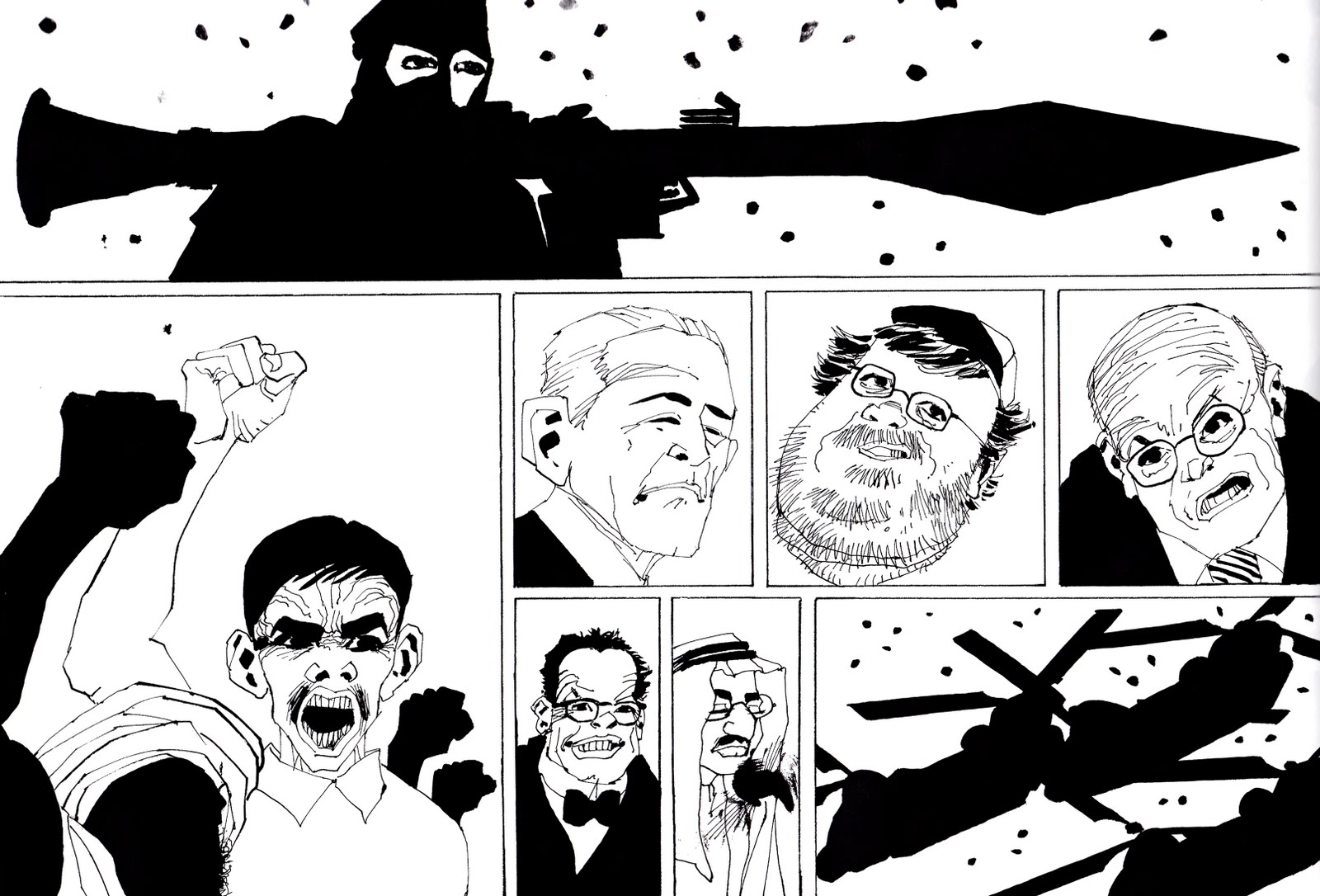
Some reviewers have criticized the lack of characterization of the Fixer. Supposedly, since he isn't Batman, we need backstory, characterization, some reason to sympathize. Despite certain deliberately non-Batman moments (the Fixer uses guns, he explicitly says he suffered no childhood tragedy at the hands of crime), the Fixer is unmistakably Batman—not the Batman of lore and continuity, but Miller's Batman. Miller has earned the right to tell stories with that icon, and he clearly does so here, even after discarding the baggage the historical DC Batman has accumulated over the years as part of his mythos.
Miller's Batman was a Batman pushed to the breaking point, turning his frustration at the world into violence. Unabashedly taking justice into his own hands, a vigilante in the purest, truest sense—however ugly such a thing may be. Targeting fascists, he himself was also a fascist. Just the right fascist. This was the message already in Dark Knight Returns, and the Fixer is in many respects the logical extension of this idea.
In Holy Terror, the climactic terror event, the proxy for 9/11 (after a sequence of nail bombs explode all over the city), occurs when terrorists fly an airplane into a large statue on the city's waterfront. Reviewers have commented on the obvious similarity with the Statue of Liberty, and one even claimed a simplistic liberty-oriented symbolism: "The terrorists somehow scramble fighter jets (several of them) to blow up a thinly veiled Statue of Liberty (because they hate us for our freedom)."
But this interpretation is bizarre. Although it obviously references the Statue of Liberty, Miller's statue is of Blind Justice. And this is no mistake, for liberty is not a virtue in Miller's world. It is not freedom, but justice which reigns supreme in the world of the vigilante, and it is the destruction of justice for which Miller faults the terrorists, not of liberty. Likewise, it is not even the defense of justice which motivates and explains the actions of the Fixer, but rather the realization of justice. It is just that the terrorists die, the consequences of the Fixer's actions to eliminate them and their collaborators beyond their deaths are simply irrelevant.

Ultimately, Holy Terror suffers from many defects. Criticisms of plot and character are not at all misplaced. But the book works at the level of a rant, and it is a rant of beauty and passion. The art is indeed uneven and schizophrenic, but here again, every style has its moment. More importantly, the unevenness of the art strengthens the feeling of raw power. It's as if Miller is blinded by his own emotions, he can't even see straight while caricaturing Obama, or Michael Moore, or whoever those are supposed to be; he can't even put into words his response because it occurs at gut level. There is no reason, no rationality behind the response, just an intense feeling of injustice and a fantasy to respond and correct.
And in this sense, Holy Terror is more honest and true than many responses to 9/11. There's no pretense here, for better or worse. And let's not forget that Miller is still (at least) a profound talent with images. However chaotic the emotions, facile the story, or uneven the storytelling, Miller can still make the jaw drop with his neo-noir blasts of black and blood and light and shadow.
Wednesday, May 25, 2011
Sunday, May 22, 2011
bilal's evolving revolutionary

Enki Bilal is a comic book illustrator/writer and movie writer/director who was born in Yugoslavia in 1951 and emigrated to France at the age of nine.
Bilal's art and vision are magnificent, both on the page, and on celluloid, but a theme which runs throughout all his major works (including those he only illustrated) is the role of the revolutionary. It's natural to assume that the atmosphere in post WWII Belgrade influenced this trend, plus perhaps, and more personally, his own family's history (apparently, his father was once a tailer to Tito; more importantly, his father was Bosnian, while his mother was Czechoslovakian).
For whatever reason, the revolutionary, the anti-establishment anti-hero, has featured as a leading character in all of Bilal's significant works. The role of this character, however, has evolved over the course of Bilal's career: from hopeful successes, to temporary victories, to pessimistic post-heroes, doomed to relive the consequences of their revolution(ary act), without even the recollection of its motivation.
The initial phase is clearly visible in Bilal's work with Pierre Christin, who wrote a trilogy of fanciful political commentaries for him, eventually collected as Townscapes. In each of these three stories, a mysterious stranger interferes in some bizarre way to bring about a surreal political statement, heartily endorsed by local disaffected townspeople. In the first two, Cruise of Lost Souls (1975) and The Ship of Stone (1976), there's a strong sense that change is achieved, if only on the local level.
With the third book in the trilogy, however, The Town that Didn't Exist (1977), a strange foreboding appears. The local factory has been shut down, and the workers protest for better wages and benefits. When the old man who owns the corporation dies, his crippled daughter inherits his wealth and his business. She employs her financial resources and political influence to construct a utopian dream city for the inhabitants of the old town—here they may do as they please without worries about finances or security.
Here, the progressive social goals of the trilogy's enigmatic protagonist appear to have been achieved, yet when he leaves the new city, he is joined by several of the former factory workers, one of whom proclaims "that town doesn't really exist." Interpretations abound here—is utopian success a dream? Is philanthropic behavior such as that of the daughter in principle impossible in capitalist society? Or is it the workers who are blind to what they can achieve, who doubt the validity of the Marxist utopia that could await them if only they found the right resources? The text is silent on interpretation, but the darkness and ambiguity of the ending casts a long shadow over the earlier stories.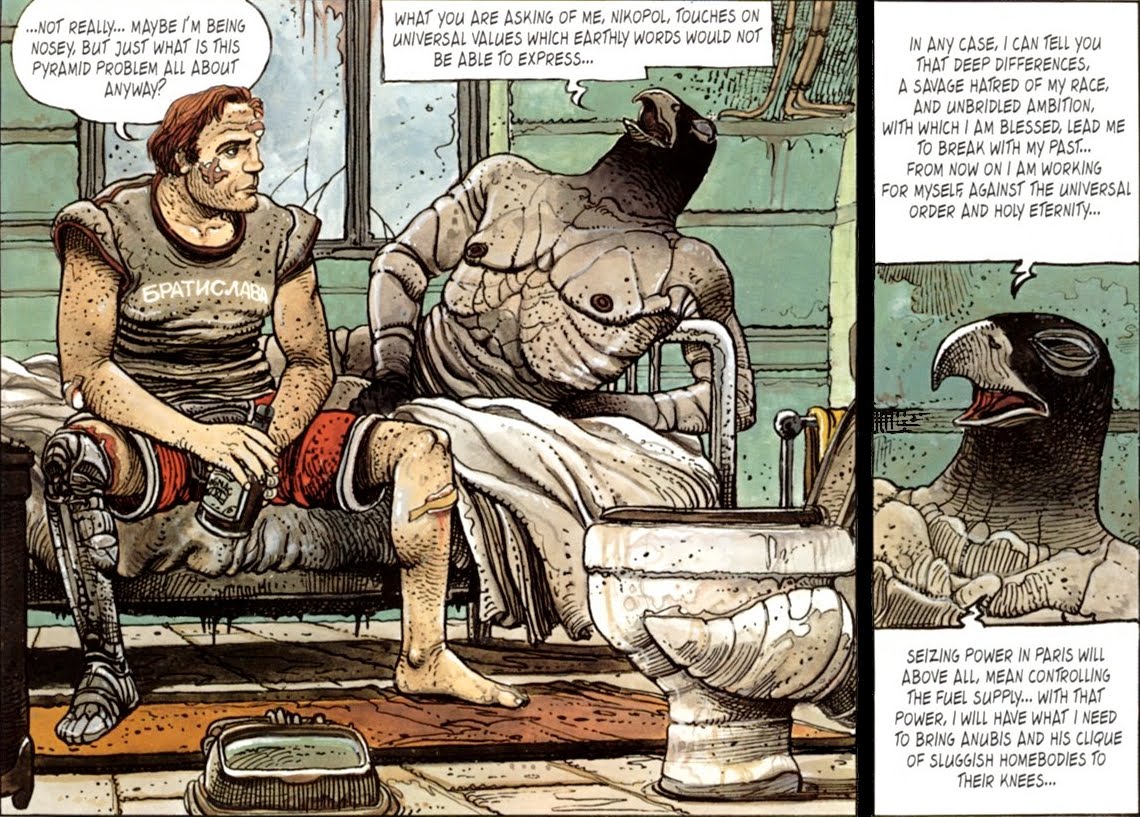
Perhaps the most optimistic of Bilal's revolutionary stories can be found in the first volume of the Nikopol trilogy, his most famous work. The titular character, Alcide Nikopol, unlike almost any other Bilal hero, is not actually a full-fledged revolutionary, but a mere deserter, sentenced to life-long hibernation. When incompetence awakes him on a corrupt future earth, he is partnered with Horus, a "revolutionary" figure in the pantheon of Egyptian gods. Horus wields his supernatural powers to place Nikopol in political power over the Paris of 2023. A fascist dictatorship is overthrown, Nikopol is free to implement the progressive policies of his choice, and Horus abandons control of him for more godly matters.
Yet, despite La Foire aux immortels (1980) evincing the first instance of widespread political control and change achieved by a revolutionary (albeit a reluctant one), the atmosphere at end is far from optimistic. Nikopol goes mad and his son (who looks like his twin due to Nikopol's period of government mandated suspended animation) is placed in control in his stead. By volume 3, Froid Équateur (1982), just a few years later, we learn that Nikopol's son's progressive government has been overthrown by the fascists: revolution is short lived. And Horus himself, the revolutionary deity, is on the run throughout the entire trilogy, defeated multiple times by his peers. (Though in the final scenes of volume 3, after the Egyptian gods' pyramid-shaped space ship is accidentally destroyed, Horus' leadership is finally welcomed.) 
During the decade+ it took to complete the Nikopol trilogy, Bilal collaborated again with Pierre Christin on The Black Order Brigade (1979) and The Hunting Party (1983) (collected as The Chaos Effect). Both books paint a much bleaker picture of the revolutionary than Bilal's earlier work with Christin. The Black Order Brigade, in particular, features the first introduction of a common theme in Bilal: the ex-revolutionary. Here, a group of passionate progressives who had fought in the Spanish civil war, reconvene in their old age to combat the titular "black order brigade," a fascist death squad with whom they had had many skirmishes during their glory days.
Unlike in the war itself, however, when the young progressives had been suffused with idealism and optimism, they find their new quest quickly sours. The pains of old age, the indifference of the general public, and the futility of correctly conveying their message (in the media, they are treated as terrorists, no different from their fascist counterparts) drag down their spirits and motivation. By the end, they succeed in eradicating the black order brigade, but at the cost of all lives but that of the original organizer and narrator. In the final panels, as he relates the conclusion to their saga, he mournfully proclaims "I . . . got all my friends killed for a reason I can't even really remember anymore."
Ironically, the mysterious traveling revolutionary of the earlier Bilal / Christin collaborations makes a brief appearance as an accomplice—sympathetic to the cause, but largely outside the specific plans and woes of our heroes. This war is not for him, and its Pyrrhic "victory" hints at the impossibility of radical social change. Idealists cannot succeed, and, more importantly, they cannot even maintain their idealism should they try.
In The Black Brigade, ex-revolutionaries choose to resume their activities, with ambiguous, arguably disastrous, consequences. In Bilal's films, e.g. Tykho Moon (1996) and Immortal (2004), the lead characters are ex-revolutionaries forced back into revolutionary action. In the case of Tykho Moon, the title character is a former revolutionary suffering from complete amnesia. He recalls neither his revolutionary acts, nor why he engaged in them.
Nevertheless, Tykho is forced into transgressive acts anew by the bizarre lunar dictatorship of the Mac Bee family, whose degenerative disease demands organ transplants, and with whose genetic code Tykho is uniquely compatible. Although Tykho eventually succeeds in executing the last of the Mac Bees and escapes the moon with his love interest (herself a hired killer and former employee of the dictatorship), the motive is never revolutionary change, but mere survival. An actual revolutionary (from earth) who assists him is spurned on the the topic of political idealism and dies in the violence of the finale.
In Tykho Moon, we see the personal details of life (survival, love, the chance to dance with a beautiful woman) overwhelm revolutionary priorities. One who simply lusts for a life to himself is forced into revolutionary action, and consequently, his actions are drained of idealism, and suffused instead with necessity. Obligation, unavoidable and personal. At the end, although the dictators are overthrown, we are given no promises about the future political situation on the moon. Our heroes do not aim at reform, merely survival.
Similar themes can be found in Immortal, Bilal's screen adaptation of his own Nikopol trilogy. Unlike the Nikopol of the comics (and much like Tykho Moon), the Nikopol of Immortal is an ex-revolutionary. He has been sentenced to 30 years imprisonment in suspended animation on a floating prison. A freak accident sets him free prematurely. The fascist NYC in which he finds himself is ruled by a "medical dictatorship," but his name survives as a rallying cry (the "spirit of Nikopol") amongst those who oppose the regime.
Just as in the books, a large chunk of plot is devoted to Horus' attempt to impregnate Jill via Nikopol. Just as in Tykho Moon, the very personal goals of love and survival motivate Nikopol's actions, and the execution of fascist dictators and general social upheaval which take place along the way are largely incidental. In Immortal, not only the whims of the fascist elite, but also those of the gods force Nikopol and Jill into a sequence of bizarre situations. No longer is the blame for the revolutionary's actions foisted solely upon the state—here fate, or at least its proxy, are equally, if not greater to blame.
So, while Bilal has continued to focus on the revolutionary as character throughout his career, we see a gradual evolution from the revolutionary as active instigator of social change to the revolutionary as accidental instigator of social change. The reluctant revolutionary is at first forced into this position by the very authority figures he eventually destabilizes, though later, it is fate, or forces beyond his control generally rather than merely political forces which motivate his actions.
The most recent chapter in Bilal's evolving depiction of revolutionaries is the so-called "Hatzfeld tetralogy." Unfortunately, only the first two volumes are available in English (as The Beast Trilogy: Chapters 1&2), so the overall trajectory of the work is as yet unclear to those of us who are linguistically limited. So far, many similarities emerge with Bilal's earlier works. Just as in the Nikopol trilogy, the backstory is elaborate, involving various layers of authoritarianism and fascism. Religious dictatorships, terrorist NGOs, evil policemen, bizarre alien intrusions, all make an appearance, buffeting the world our characters inhabit.
Unlike in the works discussed above, the protagonists are not (yet) explicitly terrorists themselves, but rather mercenaries, scientists, and prodigies for hire to the various competing forces which shape their world. No longer is there an "evil" authoritarian power force, and a "progressive" outsider revolutionary, but rather a sequence of authoritarian forces with various religious and political motivations. There is no "right" side for the would be mercenary to choose, and given the trajectory of alienation from idealism we've seen in Bilal's previous works, it's perhaps unsurprising that the protagonists here do not begin with an ideology, but rather a skill set of interest to ideologues.
The Hatzfeld tetralogy draws more explicitly on Bilal's Yugoslavian heritage than any of his previous works. The story centers around a trio of "Yugoslavians" of different ethnic and religious backgrounds. Their origin is retold by the protagonist Nike Hatzfeld, who's gift is a complete photographic memory (contrast with Tykho's amnesia!) which dates back to his very first days of life, when he and Amir and Leyla (the other two Yugoslavian orphans) lie next to each other in a Sarajevo hospital as it is ripped apart by violence. 
The chaos of the future world inhabited by Nike, Amir, and Leyla somehow mirrors the violence of the dissolution of Yugoslavia. Bilal focuses on individuals buffeted by larger political and religious forces beyond their control. The revolutionary becomes an employee when there is no right or wrong, but only conflict.
[If we're lucky, the re-emergence of Humanoids as a North American publishing force will result in new editions of the Nikopol trilogy (now, sadly out of print and exorbitantly priced) and the Hatzfeld tetralogy.]
Friday, May 20, 2011
cannes = nazi
What does it mean to sympathize with an ideology? Does saying you sympathize with it qualify you as sympathizing with it?
(Even if you are obviously joking, say? And you say you are joking, and you are referencing the particular details of your personal life (say, you are raised by a Jewish father and told by your mother on her deathbed that he was not in fact your biological father)? And you explicitly reject those features of the ideology which are damning (e.g. WWII) and emphasize your sympathy for the human being (no matter how "evil") who inspired the ideology rather than the ideology itself?)
Or is sympathizing with an ideology acting upon it, say by demonstrating fascist ideology through the censure and control of the speech and acts of individuals? Who here is acting "contrary to the ideals of humanity and generosity"? Who here is the real nazi?
(Even if you are obviously joking, say? And you say you are joking, and you are referencing the particular details of your personal life (say, you are raised by a Jewish father and told by your mother on her deathbed that he was not in fact your biological father)? And you explicitly reject those features of the ideology which are damning (e.g. WWII) and emphasize your sympathy for the human being (no matter how "evil") who inspired the ideology rather than the ideology itself?)
Or is sympathizing with an ideology acting upon it, say by demonstrating fascist ideology through the censure and control of the speech and acts of individuals? Who here is acting "contrary to the ideals of humanity and generosity"? Who here is the real nazi?
Monday, November 8, 2010
this is slave training
Even the NY Times is agreeing with Alex Jones? These truly must be end times.
Thursday, July 15, 2010
we no longer support . . .

"We no longer support signing in with your old YouTube password."
Am I the only one who thinks this is insane? It's one thing for Google to buy YouTube, it's another thing entirely for them force pre-takeover users to acquire Google accounts. How is this an instance of "Don't be evil"?
++++++++++++++++++++++++++++++++
update july 22 2010
Since the above, youtube now seems to sign users out whenever they sign out of gmail. This is can be inconvenient.
Friday, July 2, 2010
the life and times of martha washington

My interest in comics has waxed and waned in several waves, but the first major wave came in the late 80s when I first saw Frank Miller's Ronin. This was a little after it first came out, and I vividly remember the excitement I felt when, finally in the know, I walked away from the comic "shop" (barely more than a kiosk) with Batman: The Dark Knight Returns #3 and Watchmen #11, hot off the presses.
After Dark Knight and Watchmen set the bar so high, where to look next? An obvious choice was Give Me Liberty (1990), a four issue miniseries written by Dark Knight's Miller and illustrated by Watchmen's Dave Gibbons.
Now Gibbons' line has always seemed too clean and sterile to me. In fact, I was not that big a fan of his reading Watchmen, but his sheer connection to it (plus the obvious subtlety and detail with which he'd realized that complex project) made me enthusiastic for his work on the collaboration with Miller.
At the time, I had mixed feelings about Give Me Liberty. The story was over the top, the imagery was crazy and powerful, and Miller and Gibbons brought their distinctive personalities together into an explosive synthesis. Nevertheless, something felt unfinished, unsatisfying about the story. It was so sprawling, I felt something was left behind, even if I couldn't quite put my finger on it.

I had a vague sense more stories featuring the hero of Give Me Liberty, Martha Washington, had been published. But this was a period when my interest in comics was waning, and I never really followed her saga after the initial series.
Now, finally, however, the entire story (birth to death!) of Martha Washington, originally told in three miniseries and a handful of special issues, is collected in one place, the 600+ page The Life and Times of Martha Washington in the Twenty-First Century.
Martha is born in 1995. After a difficult youth in the ghetto, she joins "PAX," the near ubiquitous US government peace-keeping force. By the end of the first miniseries, the inevitable corruption of US economic policy, environmentalism as facism, state-instituted medicine as facism, the war on red meat, the oppression of the Apache Nation, and more have all been explored to satiric effect.

The second miniseries, Martha Washington Goes to War (1994), begins during the Second US Civil War. Martha defects to a utopian organization of the intelligent and competent, who have removed themselves from the totalitarian system which has taken over the former US. (Apparently, this story line is based on Atlas Shrugged.) Weather satellites, invisibility technology, giant golden pyramids, evil robot surgeons, and a omnipowerful super computer all play a part.
The third miniseries, Martha Washington Saves the World (1997) goes even farther over the top, pitting alien technology against a worldwide conspiracy. Finally, in 2007, Martha Washington's death was depicted in a final one-shot.
Reading Give Me Liberty again after all these years I've been reminded of just how exciting bizarre the story and its imagery were. I definitely have a greater appreciation for Gibbons' penmanship, and the color is extremely elegant. The same lingering feeling of unease, or of too much craziness and not enough depth in the characters / story remains. Nevertheless, the initial miniseries stands as a remarkable achievement.
Reading the rest of the story, its hard not to be distracted by the dramatic evolution in the coloring style. The second miniseries was a testing ground for a palate of new coloring techniques made possible by the digital computer, including even the flagrant pasting of photographic images into the backgrounds of some panels.

Here, Washington discovers the utopian hideout and the lush green imagery literally pasted in creates a surreal effect and sharp contrast with the postapocalyptic wastelands we've seen so far in the story. Although tree photos are clearly pasted in to stand for trees, some of the pasting clearly plays a textural role, like the grass image pasted onto the hill, but not matching in scale or feel with the inked outlines of tufts of grass.
The use of digital techniques is even more extravagent in the third storyline, as a rogue asteroid and various astronomical structures are generated completely digitally, with no inked line at all. Here the final confrontation with the omnipresent intelligent computer system takes place within an entirely digital environment.

Frankly, I prefer the colors and look of the first series (airbrush? watercolor?) to that of the later ones. Still, the digital excesses in the art are strangely appropriate to the narrative excesses of Frank Miller—in Martha Washington's epic, we can see the terse social commentary of the early Miller evolve into the carnivalesque self-parody on display in, for example, Batman: The Dark Knight Strikes Again. In the case of Batman, however, the "world" at stake (Batman's Gotham) was not really large enough to contain Miller's excess. In contrast, the world of Marha Washington is free to expand along with the style in Miller's sequels, consequently these work much better than DK2.
Ultimately, I think Martha Washington is one of the those characters loved a little too much by its creators (the deep affection both Miller and Gibbons feel for the character is attested repeatedly in the volume's liner notes). This makes certain features of her saga overly self-indulgent for my taste. Ultimately, however, the saga is deeply satisfying—perhaps some of their love rubs off on the reader. Or maybe the global vision presented is thought provoking enough to forgive some gaps in motivation or character.
More than that, however, the grandiose vision laid out of the future is so lighthearted and good spirited (despite the dark satire, it's always fun), that one can't help but play along, allow M&G their indulgences, and applaud an epic that manages to be grandiose and silly, brutal and lighthearted, frustrating and entertaining, all at the same time.
Saturday, April 24, 2010
everybody draw muhammad ~ may 20
If our government won't stand up for us and our corporations only cower in fear, it falls upon the individual to keep the world safe for free expression by banding with his peers in a show of solidarity. If terrorists wish to control us through threats and fear, then we must banish that fear from our hearts and rise up to meet the challenge. Safety in numbers has been the watchword of all peaceful movements to change the world. Maybe fighting the close-minded, terrorist fascism of muslim fundamentalism can also be peaceful ~ why invade when we can take the moral high ground and draw!
We lost - you know what I mean? Something that was ok is now not ok, and that's just . . . fucked up.
Are you afraid that if the network allows you to unveil the prophet Muhammad that you will be bombed?
We'd be so hypocritical against our own mess... - our own thoughts if we said, "ok well let's not make fun of them because they might hurt us," like, that's messed up! - to have that kind of thought process, you know? ok we'll rip on the catholics cause they wont hurt us, but we won't rip on them cause they might hurt us?!?!?! Like that's, that is not what we -
It so sad that the whole Muhammad . . . the whole Danish cartoon thing . . . it's like if everyone would have just, like normally they do in the news organizations, just printed the cartoons -
Right, and no one rallied together -
Now that guy had to be in hiding, and all this shit, because no one, everyone kinda left him out to dry.
That's a big problem when you have, like, the New York Times and Comedy Central and Viacom basically just pussing out on it, I'm sorry to say. It's just sad. It's sad. I was like really sad about the whole thing.
So, help make the world a better place and participate in Everybody Draw Muhammad Day on May 20.
I know I will, will you?
Friday, April 23, 2010
south park solidarity
Any self respecting government refuses to bow to terrorist threats. If they allow terrorists to determine policy through the threat (or even the implementation) of cowardly violence against innocents, then that government is no longer autonomous—if others control your behavior through violence, you are a slave.
However, if the citizens and private organizations of a community themselves succumb to terrorist threats, the situation is no better than if the government itself had. For what is the government but the collective will of the individuals that comprise the state?
Comedy Central recently succumbed to terrorist threats and edited the 201st episode (season 14, ep. 6) of the TV show South Park. This episode depicted a number of religious figures and celebrities in humorous situations. One such religious figure was Muhammad, who was envied by all other celebrities precisely because he had the power of not being ridiculed. (Muhammad himself is depicted as an associate of the other religious figures who don't give a damn about such nonsense, as is fitting of a religious figure.) It ended, as all South Park episodes do, with a moral message. Comedy Central blacked out all appearances of Muhammad, bleeped out his name whenever it was uttered, and bleeped out the ending moral message, which "was about intimidation and fear," and "didn't mention Muhammad at all."
It is embarrassing that we live in a country were private businesses don't feel free to allow expression without fear of terrorist reprisal.
It is cowardly of Comedy Central to submit to terrorist threats (and vague, insubstantial ones at that) rather than stand by their content providers.
But it is scandalous and offensive that a moral message emphasizing the dangers of intimidation and the importance of resisting terrorist-imposed fear was also censored in response to nebulous terrorist threats.
Shame, shame Comedy Central you spineless Quisling, you patsy of the enemies of freedom, you embarrassment to free-thinking, liberal-minded citizens of the world. You enemy of morality. You servant of evil, oppression, and fascism!
However, if the citizens and private organizations of a community themselves succumb to terrorist threats, the situation is no better than if the government itself had. For what is the government but the collective will of the individuals that comprise the state?
Comedy Central recently succumbed to terrorist threats and edited the 201st episode (season 14, ep. 6) of the TV show South Park. This episode depicted a number of religious figures and celebrities in humorous situations. One such religious figure was Muhammad, who was envied by all other celebrities precisely because he had the power of not being ridiculed. (Muhammad himself is depicted as an associate of the other religious figures who don't give a damn about such nonsense, as is fitting of a religious figure.) It ended, as all South Park episodes do, with a moral message. Comedy Central blacked out all appearances of Muhammad, bleeped out his name whenever it was uttered, and bleeped out the ending moral message, which "was about intimidation and fear," and "didn't mention Muhammad at all."
It is embarrassing that we live in a country were private businesses don't feel free to allow expression without fear of terrorist reprisal.
It is cowardly of Comedy Central to submit to terrorist threats (and vague, insubstantial ones at that) rather than stand by their content providers.
But it is scandalous and offensive that a moral message emphasizing the dangers of intimidation and the importance of resisting terrorist-imposed fear was also censored in response to nebulous terrorist threats.
Shame, shame Comedy Central you spineless Quisling, you patsy of the enemies of freedom, you embarrassment to free-thinking, liberal-minded citizens of the world. You enemy of morality. You servant of evil, oppression, and fascism!
Subscribe to:
Posts (Atom)