
Showing posts with label chaos. Show all posts
Showing posts with label chaos. Show all posts
Monday, October 2, 2017


Friday, March 8, 2013
von der oberseite des reichstag

In ihrem gemeinsamen Mund
lebt ein "Kolibri"!

Mit jedem seiner Flügelschläge
dafür das Auge viel zu träge
Kulturen erblühen und vergehen
ganze Kontinente untergehen
Hier gibt es keine harmlosen Worte
alle viel zu gross . . . .

Wärend nur eines Augenaufschlags
haben sie geputscht!
die Regierung gestürzt
Parlament aufgelöst
haben Wahlen abgehalten
das Ergebnis annulliert

haben Wahlen wiederholt
sind letztendlich exiliert
von Geschichte ausradiert
Ich durch den Dreck bedeutender
Metaphern

Meta, Meta. Meta für Meter
mit Gesten viel zu breit
für die Imterimsliebenden
~ Blixa Bargeld, 1992
Thursday, May 17, 2012
contempt vs. love: versus
Can love survive contempt?
Or, perhaps, does love depend on contempt?
Andrzej Żuławski's (1975) L'important c'est d'aimer ("The Most Important Thing is To Love", we'll call it "Love" for short) can be read as a commentary on and response to Jean-Luc Godard's (1963) Le mépris ("Contempt")—a commentary which holds up a funhouse mirror to Godard's film and inverts all its basic themes.
Although L'important c'est d'aimer is clearly a commentary on many French films, its special relationship to Contempt is signaled early on by its strikingly similar use of music. Not only are the scores of both films by the same composer, Georges Delerue, but the themes are strikingly similar, and used in very similar ways, i.e. sharply inserted over relatively mundane scenes between long stretches of unscored dialogue.
Additionally, there are further thematic overlaps: both films are stories of infidelity, in the entertainment world (theater; film), with a bizarre commentary on a famous earlier work thematically interwoven (Contempt: The Odyssey; Love: Richard III).
And both movies are about the relationship between love and contempt.
But the relationship between love and contempt is strangely reversed in the two movies.
In Contempt, a young(ish) writer allows / encourages his young and beautiful wife (Brigitte Bardot!) to spend time unchaperoned with his potential employer, the producer (Jack Palance!) of an exploitation film version of The Odyssey directed by Fritz Lang (Fritz Lang!). When he refuses to acknowledge he's done something morally suspect, Bardot describes herself as feeling only "contempt" toward him. Although it is never revealed what happened between Bardot and Palance during the initial incident, she eventually leaves her husband for Palance, her love having evaporated due to her contempt.
So: for Godard, contempt is the antithesis of love.
re: The Odyssey, Palance pushes on the writer his personal interpretation of Homer's epic, namely that Ulysses is in fact reluctant to return home and deliberately prolongs his voyage because he no longer loves his wife.
In L'important c'est d'aimer a young photographer / admirer becomes enthralled with an "aging" (well, thirty) actress. Her husband allows them unchaperoned situations together, wherein she makes sexual advances, but the photographer never takes advantage of them. Her husband at one point confronts the photographer, saying he's offended the man won't even fuck his wife, and that he "needs a reprieve" from his 6 years of waking up next to her.
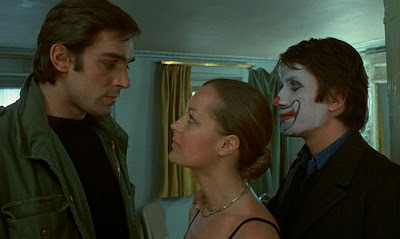
In a crucial late scene, the actress and her husband meet at a cafe of personal significance in the history of their relationship. He says that she feels only pity for him and that this manifests as contempt. He tells her that despite his desire for a reprieve, he loves her, at which point she yells in tears that "I don't even know what that means." Throughout, there is implication that, despite his buffoonery, her husband has somehow supported her through emotionally difficult times, prevented from slipping into a career of prostitution, etc.
Later, the husband commits suicide, and finally the photographer commits to a physical relationship with the actress. In the final scene, the photographer is beaten violently by gangsters whom he owes money. The actress arrives at their home, discovering him beaten, bloody, and helpless on the floor, runs to embrace him, sobbing "I love you."
re: Richard III, as the famous scene between Richard and Lady Anne is rehearsed in the play within a film in Love, the director of the play asks the actress's actual husband to lay in the coffin while she speaks her lines. Later, the scene is recreated when her husband indeed lies dead and she seeks comfort in the "murderer" of her husband, the photographer.
"Was ever woman in this humor wooed? Was ever woman in this humor won!"

So, in both films, the woman feels contempt for her husband—in Contempt, this is why she leaves, in Love, this is why he leaves.
Godard's is a conservative view of marriage—the man fails to assert his protection / sexual ownership of his wife, consequently, she leaves him for one more forceful.
Żuławski's is a bizarre looking-glass version of the control relationship in marriage: by perceiving her man as weak, the actress gains strength herself, but correspondingly drives him to suicide. She replaces him with another whom, only once she sees in him a similarly pathetic and powerless position, is she able to assert that she loves. Here, pity breeds contempt breeds (for her) love. A position which kills her husband and traps the photographer into a twisted, self-sacrificial role.
Inverted also is what we see. In Godard's film, we never see the moments where indiscretion is possible, and this ambiguity is essential in order to understand the emotional tension between Bardot and her husband.
In Żuławski's film, we see all the chances for potential infidelity in excruciating detail, and also the failure of any consummation.
But this decision is crucially tied to the inversion of the message. For Godard's heroine, it is her husband's attitude which offends her; her actions are irrelevant for that dynamic. For Żuławski's heroine, it is her own behavior towards the men around her that drives their madness. This corruptive influence is all the more interesting precisely because her character is so compelling and sympathetic. What is unseen here are not the incidents of the current love triangle, but the 6 years of marriage prior to these events, defining these characters, but elided from what we, initiates into their surface but not their secrets (as is the photographer), are directly able to witness.
Żuławski shows Godard up as a fake progressive. The supposed cynicism of Contempt is unmasked as traditionalism against the strangely believable inverted chaos of Love's romantic entanglements. True cynicism is revealed in the movie's very title, an implicit answer to an implicit question.
Le mépris?
Non, L'important c'est d'aimer.
P.S.
L'important c'est d'aimer also happens to feature the greatest Klaus Kinski scene of all time. Kinski plays the actor protraying Richard III, and it's indeed a pleasure to see him deliver the "now" speech, and seduce Anne over her husband's coffin. On opening night, though, at a restaurant afterwards, the players receive the evening edition of the paper and read a scathing review. This is Kinski's reaction:
(The two lines essential to understand this scene. First, Kinski accuses the passing drunks of "touching his coat," asserting "Since I am a well-bred homosexual, I care a lot about my things." After the beating, he remarks to the women, "If you're as vulgar as he, it will be perfect." Before leaving with them. Awe inspiring.)
Monday, January 16, 2012
sane approach to terrorism
I'd never really believed in terrorists before—I mean, I knew that in the abstract there were terrorists somewhere in the world, but they didn't really represent any risk to me. There were millions of ways that the world could kill me—starting with getting run down by a drunk burning his way down Valencia—that were infinitely more likely and immediate than terrorists. Terrorists kill a lot fewer people than bathroom falls and accidental electrocutions. Worry about them always struck me as about as useful as worrying about getting hit by lightning.
~ Cory Doctorow (2008) Little Brother
Thursday, April 29, 2010
what are things?

But what are things? Nothing, as we shall abundantly see, but special groups of sensible qualities, which happen practically or aesthetically to interest us, to which we therefore give substantive names, and which we exalt to this exclusive status of independence and dignity. But in itself, apart from my interest, a particular dust-wreath on a windy day is just as much of an individual thing, and just as much or as little deserves an individual name, as my own body does.

The mind is at every stage a theatre of simultaneous possibilities. Consciousness consists in the comparison of these with each other, the selection of some, and the suppression of the rest by the reinforcing and inhibiting agency of attention. The highest and most elaborated mental products are filtered from the data chosen by the faculty next beneath, out of the mass offered by the faculty below that, which mass in turn was sifted from a still larger amount of yet simpler material, and so on. The mind, in short, works on the data it receives very much as a sculptor works on his block of stone. In a sense the statue stood there from eternity. But there were a thousand different ones beside it, and the sculptor alone is to thank for having extricated this one from the rest. Just so the world of each of us, howsoever different our several views of it may be, all lay embedded in the primordial chaos of sensations, which gave the mere matter to the thought of all of us indifferently.

We may, if we like, by our reasonings unwind things back to that black and jointless continuity of space and moving clouds of swarming atoms which science calls the only real world. But all the while the world we feel and live in will be that which our ancestors and we, by slowly cumulative strokes of choice, have extricated out of this, like sculptors, by simply rejecting certain portions of the given stuff. Other sculptors, other statues from the same stone! Other minds, other worlds from the same monotonous and inexpressive chaos! My world is but one in a million alike embedded, alike real to those who may abstract them. How different must be the worlds in the consciousness of ant, cuttle-fish, or crab!
Thursday, July 30, 2009
information ii
Last time we considered the information in a single event and determined that a decent measure of that information might be:
I(e) = − log P(e)
Suppose, however, that we are not interested in the information in a single event, but in a source of information. We can think of this as a source of events, or a source generating signals. All that really matters is that there are a number of possibilities, and they appear with different frequencies. Let's use π to denote a source and pi to denote the probability of the ith outcome amongst the n possible outcomes π might generate.
What can we say about the information generated by this source? Well, suppose we want a measure of the average amount of information in any signal coming from this source. This could mean something like "How chaotic is this source?" Suppose we are looking at fluctuations in background radiation—are they the result of chance (i.e. chaotic) or are they remnants of communications from an alien civilization?
An equivalent interpretation is this: "How efficient is the coding of this source's signal?" If there is lots of redundancy, then there is less information in each event generated by a source. For example, if the source is generating letters of the alphabet and it generates "th" then we would not be surprised if the next symbol is "e"—if the source is generating English text, that is. This is because there is a lot of redundancy in written English. Whenever the probability associated with the next symbol drops below 1/26, i.e. whenever some symbols are more likely than others, we receive less information when the likely symbols occur.
A third interpretation here is this: "How predictable is the source?" Suppose the source is generated by the toss of a fair die and the symbol "x" is sent if the outcome is 1, 2, 3, 4, or 5, but the symbol "y" is sent if the outcome is 6. Then "x" should appear five times more frequently than "y" and we receive much less information whenever "x" occurs. So, if all we do is predict "x", we'll be right five times out of six.
So, a chaotic source is an efficiently coded source is an unpredictable source. But how can we put a measure on this property? Claude Shannon (1948) "The Mathematical Theory of Communication" argues that we need a function H which will satisfy four intuitive properties:
1. H should be continuous over the event probabilities—i.e. small changes in the probability distribution should only have small changes on H.
2. If the probability of all events generated by a source is equal (i.e. for n events, the probability of each is 1/n), then the value of H should increase as the number of possibilities increases (intuitively, there is more information in a die toss than a coin flip).
3. If the end results (the sequence of events) are generated by different probabilistic processes, but the ultimate probability of each symbol is the same, then H should return the same value in each case. For example, consider two sources, π1 and π2. π1 first flips a fair coin. If it comes up heads, it sends "a", if it comes up tails, then π1 rolls a fair die and sends "b" if the outcome if 1, 2, 3, or 4 and "c" if the outcome is 5 or 6. π2 just rolls a fair die and sense "a" if the outcome is 1, 2, or 3; "b" if the outcome if 4 or 5; and "c" if the outcome is 6. Although the signals are generated by different mechanisms, in both cases, "a" will appear with probability 1/2; "b" will appear with probability 1/3; and "c" will appear with probability 1/6. So, H should assign the same value to both π1 and π2.
Shannon proves that all functions which satisfy these three desiderata will be of the form:
Where K is a constant (essentially, it sets an origin) and the basis of the log represents a choice of units.
Shannon called H the entropy of a source. This is because it happens to be the same equation as is used to calculate entropy in statistical mechanics (note, however, that the derivation of the equation is totally different). Is there any deep connection between entropy in information theory and entropy in statistical mechanics? This is an open question about which opinions differ wildly.
Saturday, March 28, 2009
cheapening the incredible
without CGI:
The creation of an incredible event on film depends upon the ability of an individual (or group thereof) to manipulate and guide the environment, physical objects, light, time, and actors to create a particular moment.
with CGI:
The creation of an incredible event on film depends upon the ability of an individual (or group thereof) to imagine and simulate some *possible* moment.
The problem here is with possibilia. What defines the possible moment? In fact, the possible is defined by the actual - we cannot intuit or a priori predict the possible. We discover it by attempting it. Without CGI, one demonstrates the limits of the possible by testing them empirically. With CGI, one foresakes the possible (and thus the interest of its limits) for the imagination.
Here also, admittedly, there are limits - but are these as interesting as the limits of possibility in the world?
Friday, May 18, 2007
the momentum of government
The behavior of a complex system can be characterized by broad generalizations, or rules. These rules capture correlations and trends, but are not necessarily causal in nature, they emerge. Just as the behavior of a gas emerges from the behavior of its constituent particles, so the behavior of a government emerges from its constituent agencies, officials, etc. And, similar to the case of gases, where the particular types of particles which comprise the gas are largely irrelevant to its behavior as a gas, there are regularities in the behavior of governments which can be predicted and characterized independent of the specific makeup of that government. In particular, governments grow.
Government growth is an observable natural phenomenon which arises from bureaucratic organization. In a bureaucracy, there is no metric for measuring the ratio between efficacy and expense. In a market, an equilibrium is reached which maximizes this ratio (one characterization of this equilibrium point is through the notion of pareto-optimality). The flow of money provides a metric by which distance from this equilibrium point can be measured in a market. Governments are necessarily bureaucratic in structure, and a bureaucracy is not subject to market forces, and thus money cannot serve this role of metric within a government. Without a successful measure of the ratio between the costs of actions and their efficacy, however, agencies and officials within the government will be alotted funding in accordance with principles irrelevant to their success at fulfilling their intended purpose. In general, it is the lack of a well-defined goal state plus the lack of a gauge of efficiency which ensure that funding will increase, power will accrue, and any particular agency will grow. As a corollary, government as a whole will, in general, grow.
This momentum of government is entirely independent of the type of government. Monarchies, oligarchies, republics, democracies, social republics, social democracies, anarcho-syndicalist communes, etc.: all governments comprise bureaucracies and, as such, are susceptible to this same growth, this same momentum. The difference between types of governments can be measured along two parameters: 1) the number of tasks that fall under government's purview; 2) the process by which additional tasks accrue to government responsibility. In a communist society, for example, all tasks fall under government purview, and thus all tasks are carried out in a manner governed by the properties of a bureaucracy, i.e. without an appropriate metric for measuring efficiency. This is why gross inefficiency has generally been observed in communist societies. A monarchy is characterized by the manner by which tasks accrue, i.e. via the decisions of the monarch. Thus, this characterization alone does not answer the question of how many tasks fall under government's purview. Democracies require majority agreement for a new task to accrue to government responsibility, thus the growth of bureaucracy in a democracy is relatively slow, but monotonic.
This perspective provides a different explanation for the progression through various social structures as observed by Marx. Marx characterizes the trend from the bottom up, from the perspective of workers. Conversely, we can also characterize the trend from the top down, from the perspective of governments. The progression from monarchies, to democracies, to socialist societies is just an example of the gradual accretion of power to the underlying bureaucratic structure. Backlashes, as have recently occurred against communist societies, are the result of the gross inefficiency of a bureaucracy finally being challenged by those subject to it. In general, such backlashes require violent upheaval to remove tasks from the purview of government. Bureaucratic channels generally develop such that it is exceedingly difficult to purge them of power.
Can this encroaching tide be stemmed? Can a great enough dam be erected? Through one small hole in the dike erected by our forefathers ("to make all laws which shall be necessary and proper for carrying into execution the foregoing powers"), a torrent has poured through and flooded most of the countryside. We sit calmly and quibble about this and that, while we are up to our necks in water. The wise man says, he who would not drown, must choose: either plug this hole, or build a raft!
Monday, May 7, 2007
"random" and "determinate"
Do not be fooled by the dichotomy "random" vs. "law-governed." Randomness is not a property of events, it is not correlated with a particular type of cause or lack thereof. Randomness is a property of data. Consider three bodies moving in accordance with the laws of Newtonian gravity, with no additional forces acting upon them. Suppose two are rotating mutually in a plane while the third crosses this plane (between the other two) repeatedly in the course of its movement. Now, examine the system at suitably coarse, but regular intervals, marking a 1 in one's logbook if the third body is on this side of the other two and a 0 in one's logbook if it is on that side. The sequence of 0's and 1's you are left with is data about the system. As it turns out, this sequence of 0's and 1's will be indistinguishable from one which has been generated by tossing a "fair coin." In other words, there will be no discernible pattern in the data, in this sense it is random. Yet the three body system is completely determinate, every development is predictable with an arbitrary degree of precision given a precise enough knowledge of the initial conditions. Suppose one stumbles across such a system in nature, and observes it for many many years, generating a long string of data. No amount of knowledge of the laws which govern the system can allow one to precisely predict the next piece of data. This is because there exists an infinite number of solutions to the problem posed by the data one has collected, each corresponding to a different set of initial conditions and, mutatis mutandis, to a different subsequent development of the three-body system. We call a complex system with this characteristic chaotic. Most natural systems are chaotic in this sense.
Thursday, May 3, 2007
the documentarian
When a filmmaker has no budget for actors, no imagination for a script, and no guile for special effects, we call him a documentarian. He is reduced to turning his camera upon the "blooming, buzzing confusion" that surrounds him and using these chaotic events as grist for his mill. Luckily, the documentarian too has the opportunity to create. He exercises first the creative power of omission, for with his tiny lens and four-cornered frame he captures only a single perspective on an event. By selecting one perspective amongst a continuum of such possible, the documentarian squashes the subtlety and complexity of any moment into a single, simple interpretation. Later, in the darkness of his hovel, the documentarian strings these moments together into a narrative. And here again, there is room for creativity, for some moments are omitted and others rearranged, until a vast complexity has been whittled down to a simple, linear story. Modern heir to the alchemical tradition, the documentarian has performed a mystic transformation: he has made of reality, a fiction.
Thursday, April 26, 2007
the escape artist
Listen to the instruction of the escape artist: "The straight jacket is designed to hold a madman. It binds such that the chaotic and irrational movements of madmen cannot escape it. To liberate oneself from the straight jacket, one must carefully perform the correct sequence of movements. Only rational, methodical, and, above all, level-headed action can extricate one from the straight jacket." Heed the words of the escape artist, for so it is with all bonds!
the experts
The common man hides his impotence behind delusions of power. He says: my personal actions affect the entire globe! What is the source of such hubris? The common man has been led astray by the experts. The experts know they depend upon the common man for their existence; without an audience to venerate them, the experts are no longer experts, merely reluctant scholars. Only in the face of ignorance, then, can one become an expert. So the experts feed the ignorant on candied sweets and strong liqueur, they tell him "only you can make a difference!" and "unless you act there will come catastrophe!" But the common man is overwhelmed with this responsibility; like a bee trapped between two panes of glass he imitates St. Vitus until his expiration; floundering and struggling, pounding his skull against the invisible walls around him, when all along, the exit lay above his head. Better to ignore the experts and follow the example of the escape artist: seek calmly and methodically for the exit, for it is your very floundering in the face of imagined future threat which itself creates catastrophe.
Thursday, April 19, 2007
"Ismail Ax"
Man cannot help but seek meaning in chaos. A hurricane, a tidal wave, a swarm of locusts: man asks, "Why! Why! What is the meaning of this? Is it my fault?" He makes offerings to his false gods in the vain hope that they will help him imbue the meaningless with meaning, and thereby satisfy his selfish desire to be at blame. But when the source of chaos is not capricious nature but another man, how much more compelling we find this drive. Surely, despite the chaos in his actions, he must, deep down, be like me. Surely, there is a kernel of humanity in him, a soul which reflects myself, a reason which can be understood? But the "reasons" of the mad are by their very nature without reason. These are the same folly: "what is the meaning of this shape within the clouds?"; what is the meaning of the writings on a madman's arm?
Subscribe to:
Posts (Atom)