Tuesday, July 27, 2021


Monday, October 2, 2017

Tuesday, December 24, 2013

Friday, February 1, 2013
Wednesday, April 25, 2012
ode to torture porn
"Torture porn" is a derogatory term recently in vogue for describing the genre of cinema which is exploitative and centers upon the graphic depiction of torture.
What is the appeal of such a genre? Why would anyone, presumably with enjoyment, watch a movie valued (solely) for its depiction of torture?
The answer is the human condition.
Torture porn is rightly compared to porn, for both are instance of "exploitation" cinema, where exploitation here is characterized by a value measured solely in the depiction of some particular subject, not by more abstract measures of cinematic value (story, acting, dialog, etc.).
Shakespeare, for example, is the sheer antithesis of "exploitation" in this sense precisely because, even during his most ludicrous comedies, bloody tragedies, or ass-kissing historical plays, the value of the play (as we cherish it today) does not depend upon the depiction of farcical situations / violence / fawning political commentary, but upon the clever dialog and subtle characterization.
Porn is the most famous exploitation genre, exploiting the act of sex, but it depends no less single-mindedly upon the mere depiction of sex than, say, martial arts movies depend upon the depiction of a certain style of violence, westerns on a certain setting and aesthetic, horror upon creation of a certain type of suspense, etc.
So, "torture porn" is justly named, it is indeed the valuing of the mere depiction of violent acts of torture against other human beings over and above plot / dialog / characterization / production value / etc.
But why? What is the appeal, and, empirically, given its existence as a profitable genre for decades, there is appeal, of torture porn? What drives people to watch it? In what sense do they enjoy it?
Here, a compelling answer is found in the culture which is perhaps the greatest consumer (and producer) of torture porn: Japan. The 1976 film Shogun's Sadism, also called The Joy of Torture 2: Oxen Split Torturing begins with this quote:
'The weak become the victim of the strong,' is a rule of mankind. Cruelties have been inflicted everywhere since time began.
How true this observation is! But let us be careful. Let us not be swayed by utopian dreams of an equal society, where every individual is equivalent in power to another and there are no "weak" and "strong." Politically, such a situation has never been realized. Even attempts (one thinks: Soviet Union, North Korea, China, Cuba) to establish a communal society universally fail. No matter what, strong and weak separate, communities organize themselves into a hierarchy on the basis of power.
This is no less true at smaller or larger scales. Just as nations economically bully each other into engaging in particular international policies, so smaller groups (a class in elementary school, a university department, a band, a pair of lovers) inevitably establish structures of power, control, and thus hierarchy. Of course, at smaller scales, there is much more room for give and take, for the possibility of some kind of equivalence, even if it is only represented by a regular alteration in the relative positions of power.
As Baudelaire observed:
[L]ove is very like a torture or a surgical operation. But this idea can still be more bitterly expressed. Even though a pair of lovers may be deeply devoted, full of mutual desires, one of them will always be calmer, or less obsessed, than the other. He or she must be the surgeon or torturer; the other the patient or victim.
No accident that he characterized love as a "[d]readful game, in which one of the players must lose his or her self-government," for "government" in every sense is a position of power, of control. And the inherently hierarchical structure of human interactions necessitates the abandonment of (self-)government.
Torture is the purest realization of that aspect of love which mirrors the general structure of society as a whole; the necessary preconditions of the organized interaction amongst those who, without interaction, would otherwise be equals.
So, the existence of torture is the fundamental precondition for human society.
(Surely, this has already been remarked upon by Bataille?)
But this does not explain the appeal of "torture porn" the movie genre. For if it is indeed a precondition of social interaction, if it does indeed permeate every moment of our human existence, what pleasure then is to be derived from the single-minded fictional depiction of torture? What pleasure derived from the externalization, the graphical and physiological depiction, of an inherently internal and counterfactual social dynamic. "Torture porn" makes that which exists at the level of possibility, of control, of what can be achieved, visible, visceral, and ineluctable.
Here, the crucial answer is to be found in the attitude of the cinema goer to his or her positions within the many overlapping social hierarchies in which she / he participates.
Those who are resigned to their position or those who are satisfied with it, will not enjoy "torture porn."
"Torture porn" is a genre of the disenfranchised, the dissatisfied, those who desire a change (a radical, violent change) in social position. Furthermore, this desire for change must be intimately intertwined with some (subconscious? / conscious?) understanding of their social standing and a realization (even mere gut "grasping") of the relationship between their state of mind (happiness, or lack thereof, etc.) and their position within this social hierarchy.
And here, the ostensibly value-neutral flavor of this essay must end.
For, desiring a position of greater power precisely so that one might wield that power is surely morally reprehensible. To wish to dominate in principle, so one might also dominate in practice, is to succumb to sadism, evil, and the very corrupting influences of power which motivate the drive towards equality as a regulative ideal in the first place.
So, yes, the lover of torture porn may be evil.
(A Japanese example, one picked at random amongst many: Tsutomu Miyazaki.)
But this is not the only human drive which might motivate an "enjoyment" of "torture porn." And this precisely is the point, and why "torture porn" as a derogatory term is indeed unjustified, why the assumption that those who do "enjoy" it are necessarily monsters is, in fact, the true position of evil. The position assumed by the sadist, the torturer, the pervert.
For the desire to be a part of hierarchical change may be motivated not by inherent cruelty, but by pain, victimization, the realization that the lack of power one holds over one's life, that impotence, is an unfair and undesirable state. One might identify in torture porn not with the torturer, but the torturee. And not out of some misplaced (masochistic) sexual dynamic, but out of pure empathy.
For we all are tortured in this life, and to see a graphic analogical depiction of the that very whimsical "torture" to which we are every moment subject may have a profound power of catharsis.
Thus, so-called "torture porn" may be a positive force for healing, for self-realization, for release, understanding, acceptance, but also a constructive release of tension.
And this is why the critiques of Mel Gibson's Passion as mere "torture porn" are so ignorant and woefully misplaced. For this is indeed the role that the story of the passion of Christ as a mythology has always played—a role of catharsis for those subjugated by the (inevitable and universal) power structure of society. This is precisely why the story achieved the religious power it has, why it continues to be spread amongst oppressed peoples, why we see it as a positive and uplifting story. To focus on the pain of Christ is to focus on the plight of those who are not at the top of the hierarchy, of those who are subjugated, controlled, "tortured" by those with more power. That just is the religious significance of the story. That just is why it is a story about love and faith and healing and positive change for a better world.
Christ without the sacrifice would be Marx, Stalin, Castro—he would be the faux-torturee, a mere fascist, a dictator, a torturer.
What about those who identify with the torturer because they long for social change? Those who wish not to be subjugated, not merely so they can subjugate (as the serial killer or the sociopath), but so they can reap justice. Should we condone—must we condemn—those who revel in the possibility of retribution when they watch "torture porn"?
This is in many respects the predicament of Alex, who identifies with the Romans when hearing bible stories, yet whose apparently nihilistic rampages are clearly motivated to some large degree by his position of soci-economic impotence within society. His sadism amongst his droogs is precisely mirrored by the ease with which the larger political structure of society bends and controls him. Howsoevermuch we may revile him for his deeds, what are we to think of the casual manner in which his very personhood is violated against his will by grander, and indifferent social forces. Alex's cruelty is a faint reflection of that cruelty and control to which he is potentially subject by his very place within society and to which he becomes actually subject in the conceit of A Clockwork Orange.
Insofar as retribution may be just, the viewer of torture porn may identify with the torturer in clear conscience. And you, who are resigned, complicit, or who yourself inflict that social torture which he thereby escapes, have no moral standing for criticism.
But insofar as the justice of retribution depends upon a constructive drive towards the regulative ideal of equality, the identification with torturer should be tempered by an identification with torturee, for otherwise the pendulum will swing too far, the desire to supplant the inherent injustice of the hierarchical structure of social interactions will be replaced by a mere lust to occupy the domineering position in such interactions, and the altrustic communistic ideal will curdle into fascism, as it always has in political practice.
"Torture porn" then is indeed technically porn. But it is also religious text, a potential for catharsis and for the recognition of and rebellion against that very order of society which itself ensures, institutes, and institutionalizes torture.
Wednesday, June 22, 2011
Sunday, May 22, 2011
bilal's evolving revolutionary

Enki Bilal is a comic book illustrator/writer and movie writer/director who was born in Yugoslavia in 1951 and emigrated to France at the age of nine.
Bilal's art and vision are magnificent, both on the page, and on celluloid, but a theme which runs throughout all his major works (including those he only illustrated) is the role of the revolutionary. It's natural to assume that the atmosphere in post WWII Belgrade influenced this trend, plus perhaps, and more personally, his own family's history (apparently, his father was once a tailer to Tito; more importantly, his father was Bosnian, while his mother was Czechoslovakian).
For whatever reason, the revolutionary, the anti-establishment anti-hero, has featured as a leading character in all of Bilal's significant works. The role of this character, however, has evolved over the course of Bilal's career: from hopeful successes, to temporary victories, to pessimistic post-heroes, doomed to relive the consequences of their revolution(ary act), without even the recollection of its motivation.
The initial phase is clearly visible in Bilal's work with Pierre Christin, who wrote a trilogy of fanciful political commentaries for him, eventually collected as Townscapes. In each of these three stories, a mysterious stranger interferes in some bizarre way to bring about a surreal political statement, heartily endorsed by local disaffected townspeople. In the first two, Cruise of Lost Souls (1975) and The Ship of Stone (1976), there's a strong sense that change is achieved, if only on the local level.
With the third book in the trilogy, however, The Town that Didn't Exist (1977), a strange foreboding appears. The local factory has been shut down, and the workers protest for better wages and benefits. When the old man who owns the corporation dies, his crippled daughter inherits his wealth and his business. She employs her financial resources and political influence to construct a utopian dream city for the inhabitants of the old town—here they may do as they please without worries about finances or security.
Here, the progressive social goals of the trilogy's enigmatic protagonist appear to have been achieved, yet when he leaves the new city, he is joined by several of the former factory workers, one of whom proclaims "that town doesn't really exist." Interpretations abound here—is utopian success a dream? Is philanthropic behavior such as that of the daughter in principle impossible in capitalist society? Or is it the workers who are blind to what they can achieve, who doubt the validity of the Marxist utopia that could await them if only they found the right resources? The text is silent on interpretation, but the darkness and ambiguity of the ending casts a long shadow over the earlier stories.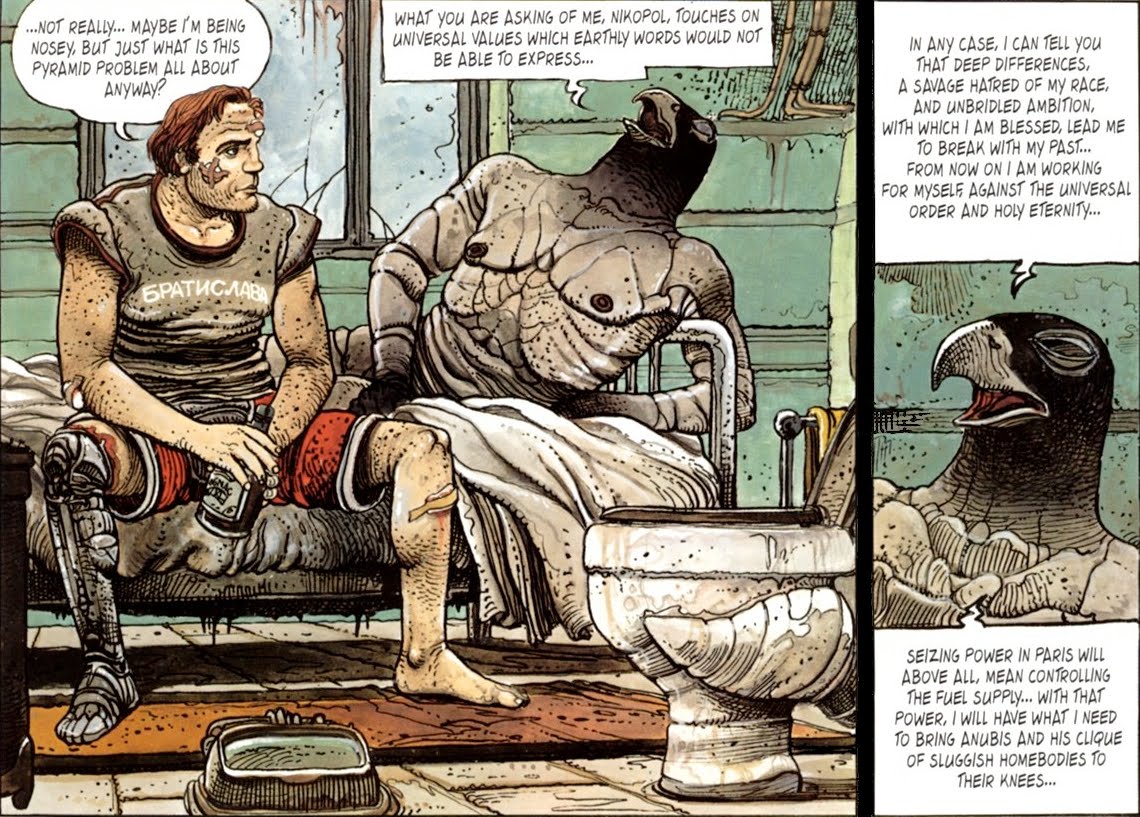
Perhaps the most optimistic of Bilal's revolutionary stories can be found in the first volume of the Nikopol trilogy, his most famous work. The titular character, Alcide Nikopol, unlike almost any other Bilal hero, is not actually a full-fledged revolutionary, but a mere deserter, sentenced to life-long hibernation. When incompetence awakes him on a corrupt future earth, he is partnered with Horus, a "revolutionary" figure in the pantheon of Egyptian gods. Horus wields his supernatural powers to place Nikopol in political power over the Paris of 2023. A fascist dictatorship is overthrown, Nikopol is free to implement the progressive policies of his choice, and Horus abandons control of him for more godly matters.
Yet, despite La Foire aux immortels (1980) evincing the first instance of widespread political control and change achieved by a revolutionary (albeit a reluctant one), the atmosphere at end is far from optimistic. Nikopol goes mad and his son (who looks like his twin due to Nikopol's period of government mandated suspended animation) is placed in control in his stead. By volume 3, Froid Équateur (1982), just a few years later, we learn that Nikopol's son's progressive government has been overthrown by the fascists: revolution is short lived. And Horus himself, the revolutionary deity, is on the run throughout the entire trilogy, defeated multiple times by his peers. (Though in the final scenes of volume 3, after the Egyptian gods' pyramid-shaped space ship is accidentally destroyed, Horus' leadership is finally welcomed.) 
During the decade+ it took to complete the Nikopol trilogy, Bilal collaborated again with Pierre Christin on The Black Order Brigade (1979) and The Hunting Party (1983) (collected as The Chaos Effect). Both books paint a much bleaker picture of the revolutionary than Bilal's earlier work with Christin. The Black Order Brigade, in particular, features the first introduction of a common theme in Bilal: the ex-revolutionary. Here, a group of passionate progressives who had fought in the Spanish civil war, reconvene in their old age to combat the titular "black order brigade," a fascist death squad with whom they had had many skirmishes during their glory days.
Unlike in the war itself, however, when the young progressives had been suffused with idealism and optimism, they find their new quest quickly sours. The pains of old age, the indifference of the general public, and the futility of correctly conveying their message (in the media, they are treated as terrorists, no different from their fascist counterparts) drag down their spirits and motivation. By the end, they succeed in eradicating the black order brigade, but at the cost of all lives but that of the original organizer and narrator. In the final panels, as he relates the conclusion to their saga, he mournfully proclaims "I . . . got all my friends killed for a reason I can't even really remember anymore."
Ironically, the mysterious traveling revolutionary of the earlier Bilal / Christin collaborations makes a brief appearance as an accomplice—sympathetic to the cause, but largely outside the specific plans and woes of our heroes. This war is not for him, and its Pyrrhic "victory" hints at the impossibility of radical social change. Idealists cannot succeed, and, more importantly, they cannot even maintain their idealism should they try.
In The Black Brigade, ex-revolutionaries choose to resume their activities, with ambiguous, arguably disastrous, consequences. In Bilal's films, e.g. Tykho Moon (1996) and Immortal (2004), the lead characters are ex-revolutionaries forced back into revolutionary action. In the case of Tykho Moon, the title character is a former revolutionary suffering from complete amnesia. He recalls neither his revolutionary acts, nor why he engaged in them.
Nevertheless, Tykho is forced into transgressive acts anew by the bizarre lunar dictatorship of the Mac Bee family, whose degenerative disease demands organ transplants, and with whose genetic code Tykho is uniquely compatible. Although Tykho eventually succeeds in executing the last of the Mac Bees and escapes the moon with his love interest (herself a hired killer and former employee of the dictatorship), the motive is never revolutionary change, but mere survival. An actual revolutionary (from earth) who assists him is spurned on the the topic of political idealism and dies in the violence of the finale.
In Tykho Moon, we see the personal details of life (survival, love, the chance to dance with a beautiful woman) overwhelm revolutionary priorities. One who simply lusts for a life to himself is forced into revolutionary action, and consequently, his actions are drained of idealism, and suffused instead with necessity. Obligation, unavoidable and personal. At the end, although the dictators are overthrown, we are given no promises about the future political situation on the moon. Our heroes do not aim at reform, merely survival.
Similar themes can be found in Immortal, Bilal's screen adaptation of his own Nikopol trilogy. Unlike the Nikopol of the comics (and much like Tykho Moon), the Nikopol of Immortal is an ex-revolutionary. He has been sentenced to 30 years imprisonment in suspended animation on a floating prison. A freak accident sets him free prematurely. The fascist NYC in which he finds himself is ruled by a "medical dictatorship," but his name survives as a rallying cry (the "spirit of Nikopol") amongst those who oppose the regime.
Just as in the books, a large chunk of plot is devoted to Horus' attempt to impregnate Jill via Nikopol. Just as in Tykho Moon, the very personal goals of love and survival motivate Nikopol's actions, and the execution of fascist dictators and general social upheaval which take place along the way are largely incidental. In Immortal, not only the whims of the fascist elite, but also those of the gods force Nikopol and Jill into a sequence of bizarre situations. No longer is the blame for the revolutionary's actions foisted solely upon the state—here fate, or at least its proxy, are equally, if not greater to blame.
So, while Bilal has continued to focus on the revolutionary as character throughout his career, we see a gradual evolution from the revolutionary as active instigator of social change to the revolutionary as accidental instigator of social change. The reluctant revolutionary is at first forced into this position by the very authority figures he eventually destabilizes, though later, it is fate, or forces beyond his control generally rather than merely political forces which motivate his actions.
The most recent chapter in Bilal's evolving depiction of revolutionaries is the so-called "Hatzfeld tetralogy." Unfortunately, only the first two volumes are available in English (as The Beast Trilogy: Chapters 1&2), so the overall trajectory of the work is as yet unclear to those of us who are linguistically limited. So far, many similarities emerge with Bilal's earlier works. Just as in the Nikopol trilogy, the backstory is elaborate, involving various layers of authoritarianism and fascism. Religious dictatorships, terrorist NGOs, evil policemen, bizarre alien intrusions, all make an appearance, buffeting the world our characters inhabit.
Unlike in the works discussed above, the protagonists are not (yet) explicitly terrorists themselves, but rather mercenaries, scientists, and prodigies for hire to the various competing forces which shape their world. No longer is there an "evil" authoritarian power force, and a "progressive" outsider revolutionary, but rather a sequence of authoritarian forces with various religious and political motivations. There is no "right" side for the would be mercenary to choose, and given the trajectory of alienation from idealism we've seen in Bilal's previous works, it's perhaps unsurprising that the protagonists here do not begin with an ideology, but rather a skill set of interest to ideologues.
The Hatzfeld tetralogy draws more explicitly on Bilal's Yugoslavian heritage than any of his previous works. The story centers around a trio of "Yugoslavians" of different ethnic and religious backgrounds. Their origin is retold by the protagonist Nike Hatzfeld, who's gift is a complete photographic memory (contrast with Tykho's amnesia!) which dates back to his very first days of life, when he and Amir and Leyla (the other two Yugoslavian orphans) lie next to each other in a Sarajevo hospital as it is ripped apart by violence. 
The chaos of the future world inhabited by Nike, Amir, and Leyla somehow mirrors the violence of the dissolution of Yugoslavia. Bilal focuses on individuals buffeted by larger political and religious forces beyond their control. The revolutionary becomes an employee when there is no right or wrong, but only conflict.
[If we're lucky, the re-emergence of Humanoids as a North American publishing force will result in new editions of the Nikopol trilogy (now, sadly out of print and exorbitantly priced) and the Hatzfeld tetralogy.]