Showing posts with label review. Show all posts

Wednesday, January 23, 2013

the greatest comics you should be reading, but aren't

We're currently undergoing a bit of a renaissance in self-published / avant garde comics. The combination of the internet and the ease of desktop publishing has allowed small scale innovation to flourish.

We're at the same time at a bit of an all time low in the "mainstream" (i.e. "big 2" direct market) comics. The flow of information the internet allows has made it easy for readers to compare notes on the abundantly clear way in which comic content is driven by editorial rather than aesthetic decisions. This is bizarre actually, because it's made big 2 comics more like Hollywood, in the sense that a) repetition (read: third-rate mimicking) of past success and b) corporate second-guessing of the tastes of a demographic they are manifestly not themselves a part of drive content. This is especially strange because in Hollywood, the motivation for this behavior is the enormous amount of money at risk. Unlike movies, however, comics take very little money and very few participants to produce. So a strategy motivated by the economic structure of one medium seems to have bled into another with a totally different economic structure.

So, mainstream fans, who love i) superheroes, ii) action, and iii) clever exploitation have been left out to dry by their long time suppliers—yet, despite the abundance of other sources for comics, it's hard to tell which might appeal to that mainstream desire for fun exploitation and which will turn out to be too avant garde / weird / inaccessible for the mainstream fan.

So, here's a first pass at a list of comics that might fly under the radar of a mainstream fan, but are worth checking out if they're dissatisfied with the big 2, but want some kind of comic experience to satisfy that itch.

Some criteria I've attempted to satisfy:

1. Series must be ongoing - there must be at least the possibility of new volumes / issues appearing in the relatively near future.

2. Subject matter must be fun exploitation, in the sense of involving action, adventure, superheroes, but not also graphic weird sex and/or violence in too much excess (where we're setting the bar for "too much" here only a little lower than DC seems to find acceptable these days, but still significantly lower than many of the old school "underground comix").

3. Weirdness / "artsiness" must be low enough that one doesn't have to be excited about "use of form" or some other deconstructionist analysis in order to enjoy the comic.

Follow links from the titles if you want to hunt any of these down.

Self-Published:

1. Copra (Michel Fiffe)

A superhero comic modeled after the old Suicide Squad (back when it was good), but filled with non-stop psychedelic invention. This comic does everything the big 2 should be doing but aren't—suck Michel Fiffe's big fat dick, DC and Marvel!

2. Decadence Comics (various)

A "comic collective" with a flagship anthology and a bunch of miniseries and short comic collections. The key here is primary participants Lando and Stathis Tsemberlidis, who share an aesthetic commitment to cool Moebius-inspired, politically interesting, but also fun and compelling sci fi. Island 3 or Olympic Games by Lando are great places to start. Stathis' stuff may be a little too psychedelic to satisfy criterion 3, but if you have a high tolerance for psychedelia, check out MOA-192B. Warning = a lot of it's silent, but the images are great.

Small Publisher:

1. Dungeon Quest (Joe Daly / Fantagraphics)

South African Joe Daly's D&D-tribute / stoner adventure is amazingly drawn and super fun to read. Some of the humor is certainly on the weird side (you can't be down on pot smoking, for example, or tiny men who are horny in a "natural" way?) but none of the violence or sexual(?) imagery is anything like as offensive and mean spirited as what goes on in DC these days. bottom line - fun. Supposedly the next volume may be the last, but given the rate at which the series has been progressing, I find that hard to believe.

2. Cursed Pirate Girl (Jeremy Bastian / Archaia)

Beautiful, elaborate art; a fun Alice in Wonderland (with pirates!) story; clever and complex humor. This is ongoing, just incredibly slow (the first half took years, we'll see how long the second half takes).

European, waiting for translation:

1. Dungeon (Trondheim and Sfar / NBM)

I don't know what it is about this series. It's magical in the best kind of way. Maybe Bone is the closest comparison coming out of the US? Anthropomorphic monsters in a sprawling, multi-generational fantasy universe—there's something disney and cute, something dark and Game of Thrones, and something that's just pure fun about it. Just like Bone, Dungeon shows that excitement can be all ages, that it doesn't need to be "dark", that it doesn't need to involve weird sex and trashy behavior.

2. "Cities of the Fantastic" (Schuiten and Peeters / NBM)

So, this one's a bit of a stretch in several ways. It's a little less exploitation and more arty (although there are consistent stories in each issue, they do focus heavily on architecture as a central plot point). Also, although it's technically ongoing in the sense that new issues may (will?) appear, the current English language ones are all out of print, and there's no definitive promise of future translations (though NBM would be a likely source if there were). But these are beautiful, and very compelling in a "HItchcock presents" meets Salvador Dali kinda way. If you see anything in this series for a reasonable price, by all means pick it up. (Oh yeah, and I put the title in quotes since the translation is terrible—future post on that at some point.)

Honorable mention:

Night Business (Ben Marra / self published)

This one's a little too violent / sexually explicit to satisfy 2. On the other hand, it's super fun. Picture the best of the trashy 80s—King of New York meets Taxi Driver by way of Beat It. Marra's at the forefront of the new exploitation movement in self-published comics and Night Business has been his most consistent and wide-ranging title so far . . .though there are some worries about how it will all pan out. Anyway, issues 1 and 2 are supposedly out of print, but Marra showed up with some at a convention recently, so it's unclear how serious to take that. He claimed he was going to finish the story as a graphic novel (?). Bottom line: if you see 'em, grab 'em.

Thursday, May 17, 2012

contempt vs. love: versus

Can love survive contempt?

Or, perhaps, does love depend on contempt?

Andrzej Żuławski's (1975) L'important c'est d'aimer ("The Most Important Thing is To Love", we'll call it "Love" for short) can be read as a commentary on and response to Jean-Luc Godard's (1963) Le mépris ("Contempt")—a commentary which holds up a funhouse mirror to Godard's film and inverts all its basic themes.

Although L'important c'est d'aimer is clearly a commentary on many French films, its special relationship to Contempt is signaled early on by its strikingly similar use of music. Not only are the scores of both films by the same composer, Georges Delerue, but the themes are strikingly similar, and used in very similar ways, i.e. sharply inserted over relatively mundane scenes between long stretches of unscored dialogue.

[Much as Cannibal Holocaust's use of a score by Jacopetti and Prosperi's composer Riz Ortolani signals it as a commentary on their documentary style.]

Additionally, there are further thematic overlaps: both films are stories of infidelity, in the entertainment world (theater; film), with a bizarre commentary on a famous earlier work thematically interwoven (Contempt: The Odyssey; Love: Richard III).

And both movies are about the relationship between love and contempt.

But the relationship between love and contempt is strangely reversed in the two movies.

In Contempt, a young(ish) writer allows / encourages his young and beautiful wife (Brigitte Bardot!) to spend time unchaperoned with his potential employer, the producer (Jack Palance!) of an exploitation film version of The Odyssey directed by Fritz Lang (Fritz Lang!). When he refuses to acknowledge he's done something morally suspect, Bardot describes herself as feeling only "contempt" toward him. Although it is never revealed what happened between Bardot and Palance during the initial incident, she eventually leaves her husband for Palance, her love having evaporated due to her contempt.

The critical scene, in which the writer encourages his wife into the potential for infidelity.

So: for Godard, contempt is the antithesis of love.

re: The Odyssey, Palance pushes on the writer his personal interpretation of Homer's epic, namely that Ulysses is in fact reluctant to return home and deliberately prolongs his voyage because he no longer loves his wife.

In L'important c'est d'aimer a young photographer / admirer becomes enthralled with an "aging" (well, thirty) actress. Her husband allows them unchaperoned situations together, wherein she makes sexual advances, but the photographer never takes advantage of them. Her husband at one point confronts the photographer, saying he's offended the man won't even fuck his wife, and that he "needs a reprieve" from his 6 years of waking up next to her.

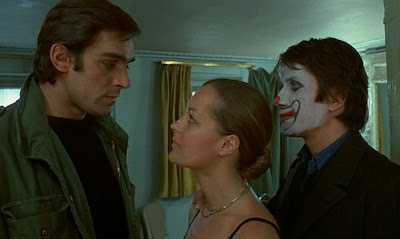
Upon overhearing the romantic conversation between his wife and the photographer, the husband literally puts on clown makeup before confronting them, and inviting the photographer to dinner.

In a crucial late scene, the actress and her husband meet at a cafe of personal significance in the history of their relationship. He says that she feels only pity for him and that this manifests as contempt. He tells her that despite his desire for a reprieve, he loves her, at which point she yells in tears that "I don't even know what that means." Throughout, there is implication that, despite his buffoonery, her husband has somehow supported her through emotionally difficult times, prevented from slipping into a career of prostitution, etc.

Later, the husband commits suicide, and finally the photographer commits to a physical relationship with the actress. In the final scene, the photographer is beaten violently by gangsters whom he owes money. The actress arrives at their home, discovering him beaten, bloody, and helpless on the floor, runs to embrace him, sobbing "I love you."

re: Richard III, as the famous scene between Richard and Lady Anne is rehearsed in the play within a film in Love, the director of the play asks the actress's actual husband to lay in the coffin while she speaks her lines. Later, the scene is recreated when her husband indeed lies dead and she seeks comfort in the "murderer" of her husband, the photographer.

Ian McKellen and Kristin Scott Thomas in a classic version of this scene from 1995.

"Was ever woman in this humor wooed? Was ever woman in this humor won!"

The topsy-turvy recreation of the Richard III deathbed wooing scene, in which the photographer asks why the husband killed himself, before being beaten, and then kissed, by the actress.

So, in both films, the woman feels contempt for her husband—in Contempt, this is why she leaves, in Love, this is why he leaves.

Godard's is a conservative view of marriage—the man fails to assert his protection / sexual ownership of his wife, consequently, she leaves him for one more forceful.

Żuławski's is a bizarre looking-glass version of the control relationship in marriage: by perceiving her man as weak, the actress gains strength herself, but correspondingly drives him to suicide. She replaces him with another whom, only once she sees in him a similarly pathetic and powerless position, is she able to assert that she loves. Here, pity breeds contempt breeds (for her) love. A position which kills her husband and traps the photographer into a twisted, self-sacrificial role.

Inverted also is what we see. In Godard's film, we never see the moments where indiscretion is possible, and this ambiguity is essential in order to understand the emotional tension between Bardot and her husband.

In Żuławski's film, we see all the chances for potential infidelity in excruciating detail, and also the failure of any consummation.

But this decision is crucially tied to the inversion of the message. For Godard's heroine, it is her husband's attitude which offends her; her actions are irrelevant for that dynamic. For Żuławski's heroine, it is her own behavior towards the men around her that drives their madness. This corruptive influence is all the more interesting precisely because her character is so compelling and sympathetic. What is unseen here are not the incidents of the current love triangle, but the 6 years of marriage prior to these events, defining these characters, but elided from what we, initiates into their surface but not their secrets (as is the photographer), are directly able to witness.

Żuławski shows Godard up as a fake progressive. The supposed cynicism of Contempt is unmasked as traditionalism against the strangely believable inverted chaos of Love's romantic entanglements. True cynicism is revealed in the movie's very title, an implicit answer to an implicit question.

Le mépris?

Non, L'important c'est d'aimer.


P.S.

L'important c'est d'aimer also happens to feature the greatest Klaus Kinski scene of all time. Kinski plays the actor protraying Richard III, and it's indeed a pleasure to see him deliver the "now" speech, and seduce Anne over her husband's coffin. On opening night, though, at a restaurant afterwards, the players receive the evening edition of the paper and read a scathing review. This is Kinski's reaction:

(The two lines essential to understand this scene. First, Kinski accuses the passing drunks of "touching his coat," asserting "Since I am a well-bred homosexual, I care a lot about my things." After the beating, he remarks to the women, "If you're as vulgar as he, it will be perfect." Before leaving with them. Awe inspiring.)

Saturday, May 12, 2012

bad lieutenant: versus

The relationship between Abel Ferrara's (1992) Bad Lieutenant and Werner Herzog's (2009) Bad Lieutenant: Port of Call New Orleans is highly ambiguous. Reportedly, Ferrara hated the 2009 version, and Herzog didn't even see the original.

As far as I can tell, Port of Call is the first produced feature script by a TV writer, although on imdb they've credited all four writers of the original as well, perhaps because there are so many plot / thematic similarities between the two movies.

Both "bad lieutenants" (i) take drugs; (ii) gamble; (iii) abuse their authority to obtain drugs; (iv) abuse their authority to obtain sexual favors; but also (v) do actually care about their role as homicide investigators and pursue it vigorously.

Additionally, the arc of both movies is similar, with a traumatic event haunting the lieutenant (original: massive gambling debt accruing as the Mets come from behind to beat the Dodgers in a seven game series; Port of Call: constant pain due to an injury suffered during Hurricane Katrina) as he relentlessly investigates a horrendous case (original: Nun raped in a church by young hoodlums; Port of Call: immigrant family slaughtered by drug lords).

Both films bear the distinctive stylistic marks of their respective directors.

But one can see the origins of Ferrara's hatred of the Herzog not-really-a-sequel, perhaps, in the radically different messages of the two films.

Ferrara's is a complex Catholic passion play. In his quest to solve the rape / desecration case, the lieutenant (re)discovers the significance of sacrifice and forgiveness in the attitude of the nun, who refuses to identifier her assailants because she has already forgiven them. Ultimately, promising her the justice she wants, he discovers their identities, but helps them escape, thereby sacrificing his own life in the process. Redemption through sacrifice and forgiveness.

Herzog's version is completely stripped of religious imagery or significance. Instead we see the images of violent nature and chaotic forces common in so many other Herzog films. Where Ferrara's lieutenant sees images of Christ's suffering on the cross, Herzog's sees phantom iguanas and break-dancing Japanese. Where Ferrara's lieutenant "solves" his case by helping the criminals escape and sacrificing his own life, Herzog's sees a bizarre twist in fortune, and arrests his criminals on phony evidence, though preventing his partner from slaughtering them on the spot, instead trusting the due process of law to see right. There is redemption here, but redemption through a combination of chance, diligence, and assistance from others.

So, Ferrara's message is quintessentially Catholic, while Herzog's is resolutely humanistic. Unsurprising, perhaps, given Ferrara's Catholic upbringing and Herzog's chaotic youth during World War II.

Friday, September 30, 2011

holy terror, batman!

Frank Miller's response to 9/11 was finally released this week. Originally conceived as a Batman tale, but repurposed to involve a generic Batman-like vigilante (the "Fixer") after DC nixed the ultra-violent spree of bigotry, hate, and inappropriate sex, the end result is still unmistakably Batman, albeit the Batman of Frank Miller.

Reviews so far have focused (perhaps unsurprisingly) on the objectionable political content. Muslims are portrayed without subtlety as evil terrorists; the heroes are devoid of character except for their righteous indignation and glee in slaughtering terrorists.

But "content," whether it be plot, character development, or political commentary is not the level of which this book was meant to work. Miller himself has described the project as "propaganda," but there is no pretense here to affect the views of the reader, to manipulate him into any particular view.

Rather, Holy Terror is a passionate rant, an explosion of pure emotion onto the page—in some cases, quite literally.

In the aftermath of the first wave.

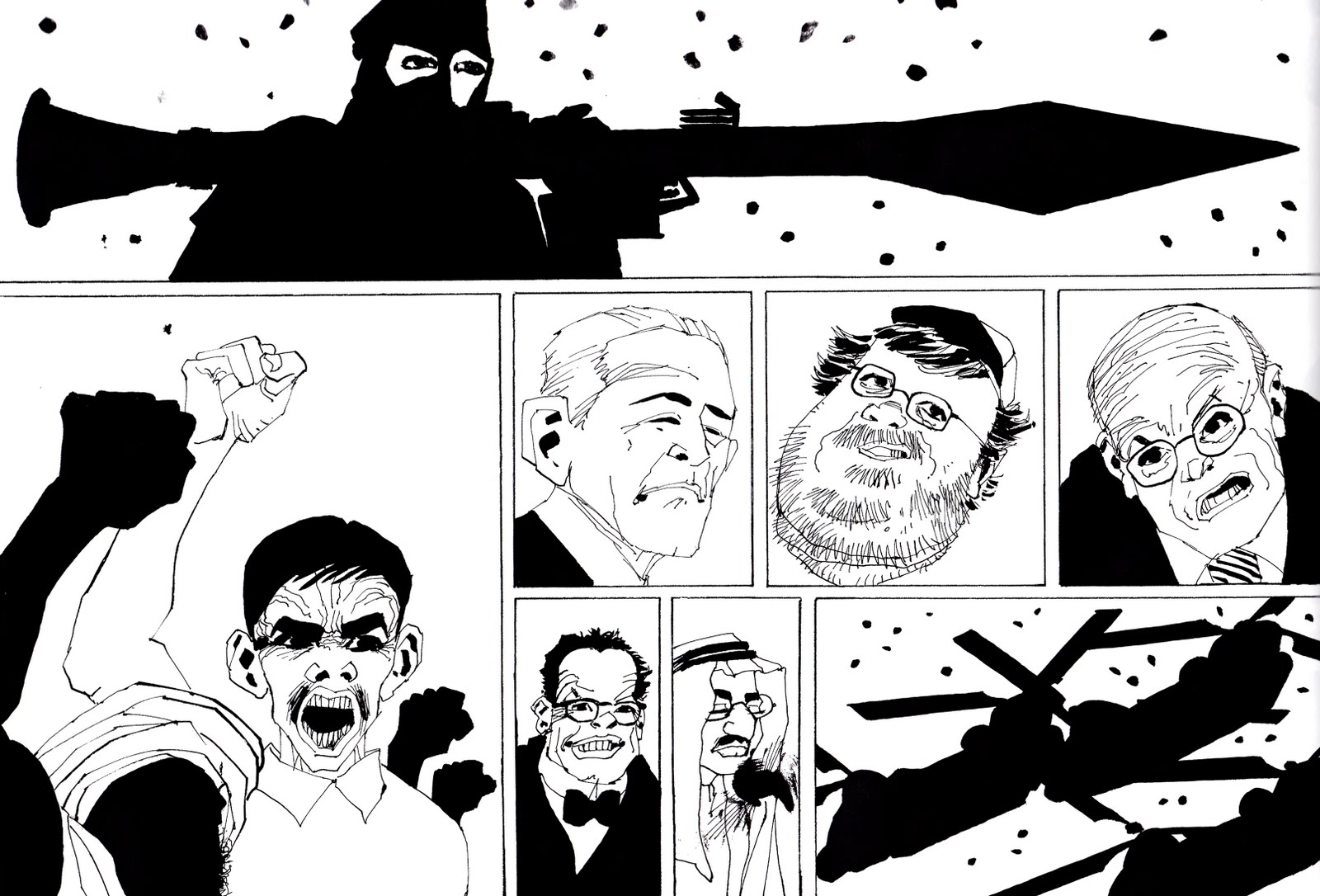
The comic works on a purely visceral level; as much a cathartic purge for Miller as anything, the reader nevertheless feels the sweep of Miller's rage, even if he can't quite grasp its target. Of course, Miller's targeting Islamic terrorists, also terrorism in general, also (perhaps) something political? Cultural? Some pages filled with caricatures and random evocative images are clearly not narrative, just splatters of Miller's scattered thoughts.

What exactly is this supposed to mean?

Some reviewers have criticized the lack of characterization of the Fixer. Supposedly, since he isn't Batman, we need backstory, characterization, some reason to sympathize. Despite certain deliberately non-Batman moments (the Fixer uses guns, he explicitly says he suffered no childhood tragedy at the hands of crime), the Fixer is unmistakably Batman—not the Batman of lore and continuity, but Miller's Batman. Miller has earned the right to tell stories with that icon, and he clearly does so here, even after discarding the baggage the historical DC Batman has accumulated over the years as part of his mythos.

Miller's Batman was a Batman pushed to the breaking point, turning his frustration at the world into violence. Unabashedly taking justice into his own hands, a vigilante in the purest, truest sense—however ugly such a thing may be. Targeting fascists, he himself was also a fascist. Just the right fascist. This was the message already in Dark Knight Returns, and the Fixer is in many respects the logical extension of this idea.

"Jihad!" . . . "Gesundheit."

In Holy Terror, the climactic terror event, the proxy for 9/11 (after a sequence of nail bombs explode all over the city), occurs when terrorists fly an airplane into a large statue on the city's waterfront. Reviewers have commented on the obvious similarity with the Statue of Liberty, and one even claimed a simplistic liberty-oriented symbolism: "The terrorists somehow scramble fighter jets (several of them) to blow up a thinly veiled Statue of Liberty (because they hate us for our freedom)."

But this interpretation is bizarre. Although it obviously references the Statue of Liberty, Miller's statue is of Blind Justice. And this is no mistake, for liberty is not a virtue in Miller's world. It is not freedom, but justice which reigns supreme in the world of the vigilante, and it is the destruction of justice for which Miller faults the terrorists, not of liberty. Likewise, it is not even the defense of justice which motivates and explains the actions of the Fixer, but rather the realization of justice. It is just that the terrorists die, the consequences of the Fixer's actions to eliminate them and their collaborators beyond their deaths are simply irrelevant.

Oh, you're surprised / offended by this?


Who are we kidding here? How short is your memory?

Ultimately, Holy Terror suffers from many defects. Criticisms of plot and character are not at all misplaced. But the book works at the level of a rant, and it is a rant of beauty and passion. The art is indeed uneven and schizophrenic, but here again, every style has its moment. More importantly, the unevenness of the art strengthens the feeling of raw power. It's as if Miller is blinded by his own emotions, he can't even see straight while caricaturing Obama, or Michael Moore, or whoever those are supposed to be; he can't even put into words his response because it occurs at gut level. There is no reason, no rationality behind the response, just an intense feeling of injustice and a fantasy to respond and correct.

And in this sense, Holy Terror is more honest and true than many responses to 9/11. There's no pretense here, for better or worse. And let's not forget that Miller is still (at least) a profound talent with images. However chaotic the emotions, facile the story, or uneven the storytelling, Miller can still make the jaw drop with his neo-noir blasts of black and blood and light and shadow.

Sunday, May 22, 2011

bilal's evolving revolutionary

Finale to The Hunting Party (1983)

Enki Bilal is a comic book illustrator/writer and movie writer/director who was born in Yugoslavia in 1951 and emigrated to France at the age of nine.

Bilal's art and vision are magnificent, both on the page, and on celluloid, but a theme which runs throughout all his major works (including those he only illustrated) is the role of the revolutionary. It's natural to assume that the atmosphere in post WWII Belgrade influenced this trend, plus perhaps, and more personally, his own family's history (apparently, his father was once a tailer to Tito; more importantly, his father was Bosnian, while his mother was Czechoslovakian).

For whatever reason, the revolutionary, the anti-establishment anti-hero, has featured as a leading character in all of Bilal's significant works. The role of this character, however, has evolved over the course of Bilal's career: from hopeful successes, to temporary victories, to pessimistic post-heroes, doomed to relive the consequences of their revolution(ary act), without even the recollection of its motivation.

Anti-gravity town making trouble for authority figures in The Cruise of Lost Souls (1975)

The initial phase is clearly visible in Bilal's work with Pierre Christin, who wrote a trilogy of fanciful political commentaries for him, eventually collected as Townscapes. In each of these three stories, a mysterious stranger interferes in some bizarre way to bring about a surreal political statement, heartily endorsed by local disaffected townspeople. In the first two, Cruise of Lost Souls (1975) and The Ship of Stone (1976), there's a strong sense that change is achieved, if only on the local level.

With the third book in the trilogy, however, The Town that Didn't Exist (1977), a strange foreboding appears. The local factory has been shut down, and the workers protest for better wages and benefits. When the old man who owns the corporation dies, his crippled daughter inherits his wealth and his business. She employs her financial resources and political influence to construct a utopian dream city for the inhabitants of the old town—here they may do as they please without worries about finances or security.

Here, the progressive social goals of the trilogy's enigmatic protagonist appear to have been achieved, yet when he leaves the new city, he is joined by several of the former factory workers, one of whom proclaims "that town doesn't really exist." Interpretations abound here—is utopian success a dream? Is philanthropic behavior such as that of the daughter in principle impossible in capitalist society? Or is it the workers who are blind to what they can achieve, who doubt the validity of the Marxist utopia that could await them if only they found the right resources? The text is silent on interpretation, but the darkness and ambiguity of the ending casts a long shadow over the earlier stories.

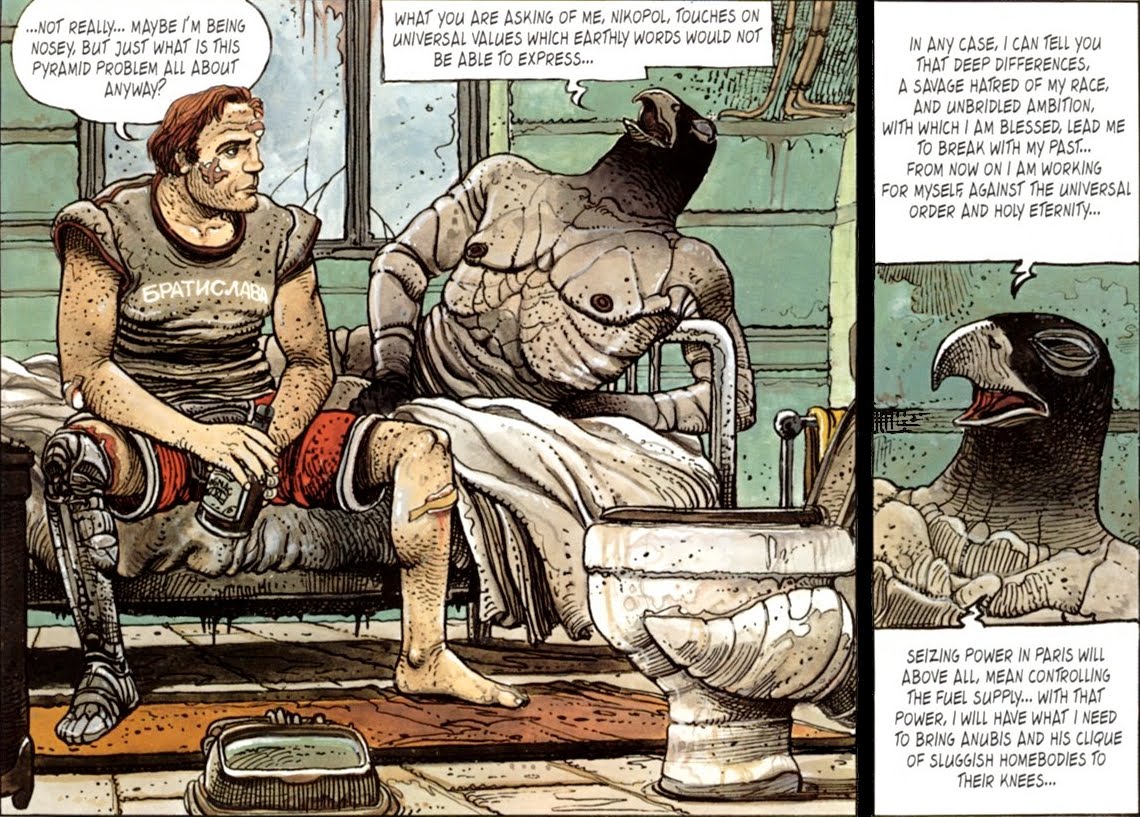
Horus chats with Nikopol about godly matters.

Perhaps the most optimistic of Bilal's revolutionary stories can be found in the first volume of the Nikopol trilogy, his most famous work. The titular character, Alcide Nikopol, unlike almost any other Bilal hero, is not actually a full-fledged revolutionary, but a mere deserter, sentenced to life-long hibernation. When incompetence awakes him on a corrupt future earth, he is partnered with Horus, a "revolutionary" figure in the pantheon of Egyptian gods. Horus wields his supernatural powers to place Nikopol in political power over the Paris of 2023. A fascist dictatorship is overthrown, Nikopol is free to implement the progressive policies of his choice, and Horus abandons control of him for more godly matters.

Yet, despite La Foire aux immortels (1980) evincing the first instance of widespread political control and change achieved by a revolutionary (albeit a reluctant one), the atmosphere at end is far from optimistic. Nikopol goes mad and his son (who looks like his twin due to Nikopol's period of government mandated suspended animation) is placed in control in his stead. By volume 3, Froid Équateur (1982), just a few years later, we learn that Nikopol's son's progressive government has been overthrown by the fascists: revolution is short lived. And Horus himself, the revolutionary deity, is on the run throughout the entire trilogy, defeated multiple times by his peers. (Though in the final scenes of volume 3, after the Egyptian gods' pyramid-shaped space ship is accidentally destroyed, Horus' leadership is finally welcomed.)

Horus takes control.

During the decade+ it took to complete the Nikopol trilogy, Bilal collaborated again with Pierre Christin on The Black Order Brigade (1979) and The Hunting Party (1983) (collected as The Chaos Effect). Both books paint a much bleaker picture of the revolutionary than Bilal's earlier work with Christin. The Black Order Brigade, in particular, features the first introduction of a common theme in Bilal: the ex-revolutionary. Here, a group of passionate progressives who had fought in the Spanish civil war, reconvene in their old age to combat the titular "black order brigade," a fascist death squad with whom they had had many skirmishes during their glory days.

The "Black Order Brigade" assassinate a leftist politician before the eyes of our "heroes."

Unlike in the war itself, however, when the young progressives had been suffused with idealism and optimism, they find their new quest quickly sours. The pains of old age, the indifference of the general public, and the futility of correctly conveying their message (in the media, they are treated as terrorists, no different from their fascist counterparts) drag down their spirits and motivation. By the end, they succeed in eradicating the black order brigade, but at the cost of all lives but that of the original organizer and narrator. In the final panels, as he relates the conclusion to their saga, he mournfully proclaims "I . . . got all my friends killed for a reason I can't even really remember anymore."

Ironically, the mysterious traveling revolutionary of the earlier Bilal / Christin collaborations makes a brief appearance as an accomplice—sympathetic to the cause, but largely outside the specific plans and woes of our heroes. This war is not for him, and its Pyrrhic "victory" hints at the impossibility of radical social change. Idealists cannot succeed, and, more importantly, they cannot even maintain their idealism should they try.

Bilal appears to be obsessed with cobalt blue . . .

In The Black Brigade, ex-revolutionaries choose to resume their activities, with ambiguous, arguably disastrous, consequences. In Bilal's films, e.g. Tykho Moon (1996) and Immortal (2004), the lead characters are ex-revolutionaries forced back into revolutionary action. In the case of Tykho Moon, the title character is a former revolutionary suffering from complete amnesia. He recalls neither his revolutionary acts, nor why he engaged in them.

Nevertheless, Tykho is forced into transgressive acts anew by the bizarre lunar dictatorship of the Mac Bee family, whose degenerative disease demands organ transplants, and with whose genetic code Tykho is uniquely compatible. Although Tykho eventually succeeds in executing the last of the Mac Bees and escapes the moon with his love interest (herself a hired killer and former employee of the dictatorship), the motive is never revolutionary change, but mere survival. An actual revolutionary (from earth) who assists him is spurned on the the topic of political idealism and dies in the violence of the finale.

Another Bilal obsession: the Eiffel Tower, not only appearing here on the Mac Bee's moon (alongside some other faux monuments and the rocket launching pad), but also in Immortal's NYC!

In Tykho Moon, we see the personal details of life (survival, love, the chance to dance with a beautiful woman) overwhelm revolutionary priorities. One who simply lusts for a life to himself is forced into revolutionary action, and consequently, his actions are drained of idealism, and suffused instead with necessity. Obligation, unavoidable and personal. At the end, although the dictators are overthrown, we are given no promises about the future political situation on the moon. Our heroes do not aim at reform, merely survival.

Similar themes can be found in Immortal, Bilal's screen adaptation of his own Nikopol trilogy. Unlike the Nikopol of the comics (and much like Tykho Moon), the Nikopol of Immortal is an ex-revolutionary. He has been sentenced to 30 years imprisonment in suspended animation on a floating prison. A freak accident sets him free prematurely. The fascist NYC in which he finds himself is ruled by a "medical dictatorship," but his name survives as a rallying cry (the "spirit of Nikopol") amongst those who oppose the regime.

Jill learns about humans (since she's quickly becoming one) in the "Human Museum."

Just as in the books, a large chunk of plot is devoted to Horus' attempt to impregnate Jill via Nikopol. Just as in Tykho Moon, the very personal goals of love and survival motivate Nikopol's actions, and the execution of fascist dictators and general social upheaval which take place along the way are largely incidental. In Immortal, not only the whims of the fascist elite, but also those of the gods force Nikopol and Jill into a sequence of bizarre situations. No longer is the blame for the revolutionary's actions foisted solely upon the state—here fate, or at least its proxy, are equally, if not greater to blame.

Horus and Nikopol's first meeting—Nikopol's reciting Baudelaire (as usual), but how does Horus know the words?

So, while Bilal has continued to focus on the revolutionary as character throughout his career, we see a gradual evolution from the revolutionary as active instigator of social change to the revolutionary as accidental instigator of social change. The reluctant revolutionary is at first forced into this position by the very authority figures he eventually destabilizes, though later, it is fate, or forces beyond his control generally rather than merely political forces which motivate his actions.

Amir's lover tries to turn him on to their next mercenary assignment.

The most recent chapter in Bilal's evolving depiction of revolutionaries is the so-called "Hatzfeld tetralogy." Unfortunately, only the first two volumes are available in English (as The Beast Trilogy: Chapters 1&2), so the overall trajectory of the work is as yet unclear to those of us who are linguistically limited. So far, many similarities emerge with Bilal's earlier works. Just as in the Nikopol trilogy, the backstory is elaborate, involving various layers of authoritarianism and fascism. Religious dictatorships, terrorist NGOs, evil policemen, bizarre alien intrusions, all make an appearance, buffeting the world our characters inhabit.

Unlike in the works discussed above, the protagonists are not (yet) explicitly terrorists themselves, but rather mercenaries, scientists, and prodigies for hire to the various competing forces which shape their world. No longer is there an "evil" authoritarian power force, and a "progressive" outsider revolutionary, but rather a sequence of authoritarian forces with various religious and political motivations. There is no "right" side for the would be mercenary to choose, and given the trajectory of alienation from idealism we've seen in Bilal's previous works, it's perhaps unsurprising that the protagonists here do not begin with an ideology, but rather a skill set of interest to ideologues.

The Hatzfeld tetralogy draws more explicitly on Bilal's Yugoslavian heritage than any of his previous works. The story centers around a trio of "Yugoslavians" of different ethnic and religious backgrounds. Their origin is retold by the protagonist Nike Hatzfeld, who's gift is a complete photographic memory (contrast with Tykho's amnesia!) which dates back to his very first days of life, when he and Amir and Leyla (the other two Yugoslavian orphans) lie next to each other in a Sarajevo hospital as it is ripped apart by violence.

Shades of Nazi death camps (and the terror camps of the Yugoslav wars are mentioned explicitly in Nike's recollections).

The chaos of the future world inhabited by Nike, Amir, and Leyla somehow mirrors the violence of the dissolution of Yugoslavia. Bilal focuses on individuals buffeted by larger political and religious forces beyond their control. The revolutionary becomes an employee when there is no right or wrong, but only conflict.

[If we're lucky, the re-emergence of Humanoids as a North American publishing force will result in new editions of the Nikopol trilogy (now, sadly out of print and exorbitantly priced) and the Hatzfeld tetralogy.]

Monday, May 9, 2011

how to film the dark tower

Apparently, there are / were plans to make a trilogy (+ TV series?) of the Dark Tower books by Stephen King. I will now tell you how to adapt the Dark Tower books to the screen effectively. Any deviations from this plan will be atrocious, I assure you.

First, a caveat: I have not actually finished the series. I read the first book many many times, and it is tied very closely in my memory to various experiences during my formative years even my love of reading itself. I read the second and third books hungrily and was quite excited by them, but did not resume consumption of the remainder until some time after the fourth was published and the series resumed.

After the third book, my experience was with audio books. I listened through about a third into the final book. I still have the audio book on my computer, but doubt I will ever be able to stomach going back to it.

The success of the first Dark Tower stories lies entirely in their imagery and atmosphere, the old west, the Beatles, dark magic—these elements seamlessly blend into an organic whole which evokes a magical picture in the reader's mind.

By the last few books in the series, however, Stephen King had fallen in love with his characters. For a storyteller, this is the death of their craft, in particular, the death of arc and character—after he fell in love with his characters, he was scared to kill them off, and, correspondingly, unable to produce legitimate tension in the story; after he fell in love with his characters, he was unable to make them cruel, and, consequently, Roland the anti-hero became Roland the kind and wise uncle whose supposed willingness to sacrifice his loved ones for the quest was given lip-service, but not realized in any convincing or tension-inducing way.

Furthermore, King's near-death experience induced him to force a post-modern turn on the series, emphasizing a multiverse perspective, fatalism, and introducing himself as a character. Fatalism kills suspense, it kills character, it removes the incentive for motivation, which drives both character development and plot—fatalism is the the bane of modern genre storytelling.

So, fuck the end to the last Dark Tower book: King, you had your chance and punted—if a Dark Tower movie adaptation is going to be any good whatsoever, it will have to follow the first rule of adaptations in a very serious way and feel free to violate the source material.

Usually this means feeling free to replace features of the source material inappropriate for the relevant new medium. For example, the Harry Potter films erred on the side of including incidents from the books rather than developing characters in the spirit of the books. Less time spent on including all the scenes from the first books in early movies, and more time spent on showing us in a manner unique to the medium of cinema the same character features that were demonstrated in the books in a manner unique to the medium of text would have greatly improved the quality and efficacy of the early movies. (I refrain from commenting on later ones as I am unqualified.)

So, the rules for adapting the Dark Tower books to the screen effectively are

1. Ignore the NYC plotline; ignore the multiverse aspect; ignore everything that is self-referential.

If the multiverse is included, everything will become convoluted, in-joke, inaccessible, and directed only at the fans or King himself. If it is abandoned, then there is some hope of telling a story which stands on its own, and is compelling to the viewer whether he has read the books or not.

2. Ignore cutesy references to other Stephen King books / The Wizard of Oz.

Same reasons as above for the first; for the second, it ridiculously undermines the atmosphere.

3. Acknowledge you cannot tell the whole story.

Making a good (series of) movies about the Dark Tower series means acknowledging you cannot reproduce every detail and nuance of the series of seven (sometimes very long) books. Confront this fact and meditate on it. If you do not, you will fail. Begin with the idea that only a very very tiny fraction of the material will make it to the screen—in the case of a series of this magnitude, we're looking at less than 1/20th, even if, say, a trilogy is green lit. Probably less.

4. Once you have meditated on 3, pick moments from the book to collect in each of the films which (a) will stand alone, (b) are cinematic, (c) will constitute a compelling story for someone who hasn't read the books, and (d) allow for an organic and internally consistent development of the characters. How many and which moments you collect will depend crucially on the scope of the series which is funded.

For example, suppose a trilogy is funded: you might break the story down such that:

I. includes the first story in detail, the discovery of the boy, and the Gunslinger's sacrifice of the boy.

II. The Drawing of the Three? Introduce the coherence of the quest, and the secondary characters? Culminate, perhaps, in the grand train journey across the radiated countryside?

III. Some kind of climax - combining features of Wolves of the Calla, and Song of Susannah with an actual confrontation with the Man in Black at the actual Dark Tower. If the cutseyness, the NYC scenes, the meta-fictional world crossing are left out, and one focusses entirely on a) scenes crucial for character development, and b) cinematic imagery which also advances story, one may be able to compress key elements together into a coherent conclusion to the story.

Then, keep the flashback story in Wizard and Glass in reserve, to use as a prequel if one hits financial gold with the trilogy.

Key point: Don't bring "the boy" (Jake) back!!!!!! Bringing back Jake was the beginning of the end for The Dark Tower—it is the abandoning of consequences, the undermining of Roland (the Gunslinger)'s character, and the introduction of multiverse, metafictional, self-indulgent, character-loving idiocy.

Follow these rules, and a powerful adaptation could be made. Abandon them in favor of the full details of the story, and you court pathetic, self-referential claptrap. Tell a good story! This is more important than faithfulness to the exact text of King's novels. Remember that it only takes one man to create a novel, but an entire team of individuals and millions of dollars to create a movie. There is much less room for ego and self-indulgence in the realm of cinema. This brings us to

5. If Stephen King doesn't sign over the rights and agree to 1, 2, 3, and 4, then don't waste any of (our) time or (your) money, just forget about the project, and go reread the books instead.

Sunday, April 17, 2011

on reading unfinished novels

There's no reason to read an unfinished novel if the author is alive. He just might finish it, for instance, and then that finished product would have the stamp of approval from an artist (presumably) one is already interested in, or at least, one has heard is worth being interested in. If that artist has produced an unfinished work worth consuming, one might as well wait until he/she is dead before consumption in order to ensure that one doesn't eavesdrop on notes and ramblings when a mature work is imminent.

[Exception which proves the rule: the recent trite crap "completion" of the Star Wars saga. nuff said.]

[Of course, in media other than the written word, unfinished status can be conferred by situations other than the writer/creator's death: go watch post haste if you have not already, Andrzej Żuławski's On the Silver Globe, the greatest unfinished movie of which I am aware—and be moved.]

There are, of course, famous examples here, e.g. Kafka's Amerika or Nabokov's Dying is Fun—although in both cases an ethical question arises since the respective authors requested their unfinished works destroyed upon their deaths.

In the case of David Foster Wallace's The Pale King, I know of no such request. The question does, nevertheless, arise: what legitimates publishing this unfinished work and distributing it widely?

Apparently, upon Wallace's suicide from depression, he left behind on his desk "a neat stack of manuscript, twelve chapters totaling nearly 250 pages" and "hundreds and hundreds" of additional pages and notes for the novel scattered about his office. (There was, however, no outline, or explicit description of the novel's intended structure and ordering of events / written sections.) His editor on Infinite Jest, Michael Pietsch, was tasked with assembling this chaos into something that could be published, and make money for the publisher / the estate.

Graciously, the details of these circumstances are described in an introductory editor's note.

So, when reading the book, there are many questions: is this the right order of the information? Would this chapter have even been included? In this form? Questions which, when reading a completed work, are not raised. And worries (questions / confusions / imaginations) about the structure of the work are no longer criticisms of the author (and, perhaps, only on some occasions criticisms of the editor), but rather merely circumstances under which one might imagine one's own perfect version of the work, or extrapolate its completion into the ideal work for you, the reader (even if not one that's realistic for the author to have produced, editor to have approved, etc.).

Was it right? ( . . . to publish this unfinished, to charge $27.99, etc.?) In the case of The Pale King, I know of no countervailing demands expressed by Wallace, and I emphatically agree with Pietsch's assessment that there is plenty here for the reading public to enjoy / value. (Even if there is some sense in which the dead are being taken advantage of, you, the $27.99 reader are not. I say this only a fifth of the way through the book, and already having earned back the cost through insight, amusement, and beatific and sublime experiences.)

The first chapter (only a page and a half) is almost worth the price of admission alone for sheer beauty. There are ups and downs, but chapter 9, the "author's forward" definitely confirms the value and insight of the work, no matter how disjoint, and (ultimately, despite the fact that only Wallace's name appears on the title page) collaborative the work in this form is. (Look, chapter 11 is just notes, it would not have appeared in a finished novel by Wallace. And the influence of its content on the novel would not have been felt at the precise place in the ordering in which it was placed. Pietsch knows this. But he acknowledges it and, more importantly (consequently?) you the reader know it as well: this affects your processing and interpretation of chapter 11.)

I have to admit, however, a spooky feeling, when reading passages like
. . . this right here is me as a real person, David Wallace, age forty, SS no. 975-04-2012, addressing you from my Form 8829—deductible home office at 725 Indian Hill Blvd., Claremont 91711 CA, on this fifth day of spring, 2005, to inform you of the following: All of this is true. This book is really true.

Of course, even in this "autobiographical" section, there are deliberate obfuscations and falsities. But from the style, from the circumstances, we know that one day Wallace sat down and wrote these words, and he wrote them from a perspective in which the novel was finished, and published, and it had only taken 3 years to write. We know that he put himself in that frame of mind, and "talked" to the potential reader. But within 3 years he had become so completely unable to find this frame of mind in which the novel was done again that he committed suicide.

This is a man talking directly to you, the reader, from beyond the grave, yet it was not him who decided that you would hear him, but his estate and publisher and editor. Again, not that that's wrong (this is the start of the aforementioned chapter 9, well worth the price of the book alone in terms of insight and depth), but that it's certainly spooky. And you allow yourself to imagine Wallace cutting it, or rephrasing it, or (more likely, my imagination), dropping the conceit that the work is real, and introducing the (admittedly, startlingly profound) discussion of the history and nature of American taxation into it in a more organic way. To imagine that this was an exercise in the style of his popular nonfiction essays to bring together information that ultimately would be more effectively (?) conveyed through fiction.

But then that's just my fantasy of David Foster Wallace, and what he might have done. But to even take the first tentative steps on this staircase, to even find a direction in which to look, is not only worthwhile, but strangely creative as a reading experience.

Sunday, December 26, 2010

translating oe

I've read every Kenzaburo Oe book translated into English. Many of these were read several years ago (in some cases as many as 15), so my memory of the translations isn't always vivid. I'm pretty certain, however, that the recent (2010) translation of The Changeling by Deborah Boliver Boehm is the worst.

At least one review has complained about the stiltedness of Boehm's prose. Comparatively, however, Boehm's translation is easily one of the most readable of the Oe works in English. The problem is in convincing oneself that Boehm has been faithful to the Japanese original.

Early in the book, it becomes obvious that she's taken the liberty of inserting expositional material for the non-Japanese reader into the body of the text (instead of into footnotes, where it belongs). For example:
... her voice had a distinct Kansai accent (that is, typical of the Kyoto-Osaka-Kobe area). (63)

On one of the major Japanese television networks there is a popular, long-running late-night program called the Wide Show that offers a combination of celebrity chat and cultural news. One night Goro, who was still working as an actor at the time, was one of the guests. (119)

The term "kansai" and the "Wide Show" would both be so familiar to Japanese readers that there would be no need of exposition. These, somewhat awkward, explanations have clearly been inserted by the translator into the text. Now, for the purist, this would probably already be enough of an offense. The real problem, however, is that there are indeed many asides and oblique references and parentheticals in Oe's writing anyway. So, sometimes, it's unclear whether an aside is his or the translator's.

For example, there is a passage where the main character, "Kogito," a clear stand in for Oe himself, discusses the New Testament's Book of Mark at the dinner table. In particular, the incident where an angel appears to women who have gone to the tomb and tells them to spread the word that Jesus is risen. The women, however, are too scared to tell anyone, and the sequence ends abruptly. Boehm gives us this sentence:

Kogito was particularly intrigued by the writers—the authors of the Bible—whose work seemed to parallel his own, and although he didn't think his own novelist's opinions had any bearing on the interpretation of the Gospel, he felt, personally, that the original author's ambiguous way of ending this particular tale was an effective literary technique. (412)

There is no definite article in Japanese, and it is tempting to think the first part of the sentence originally made the general claim "Kogito was particularly intrigued by writers whose work seemed to parallel his own". In its current form, the parenthetical either identifies the authors of the bible specifically as writers whose work parallels Kogito's own, or quantifies over them. Does Oe intend to tell us that Kogito finds, amongst authors of the bible, those whose work parallels his own interesting? Or that Kogito feels this way about all authors and identifies some of those who wrote the bible as falling into this category? Since the reader is unsure whether the aside is inserted by Boehm or in the original, the author's intent is unclear.

The intent of Oe in terms of what information he chooses to reveal and what not is especially important in understanding The Changeling. This is because Kogito is clearly a stand-in for Oe, and Goro is clearly a stand-in for Oe's brother-in-law, Juzo Itami, who committed suicide in 1997. This book is a very personal memoir about the relationship between the two, and Oe's reaction to his friend's unexpected death. Many many incidents described in the novel occurred almost identically in real life. For example, the attempt on Itami's life by yakuza thugs after his film Minbo no Onna, which ridicules the yakuza attempts at extortion, was released is described exactly as an attack upon Goro. Far more interesting (and helpful) than explaining what the Wide Show is in the above example, might have been a mention of the date of the particular event of Juzo Itami appearing on it which Oe fictionalizes!

The Guardian review, for example, explicitly bemoans the lack of this contextual information, and singles out Boehm for hurting rather than helping the situation:

Unfortunately, the reader's sense of not possessing important chunks of the background to this allusive, personal yet political novel is amplified by Boehm's translation. Her decision to use strongly American English may or may not be defensible, but she often appears to be clumsily incorporating footnote-type information into the text: "'What I'm making here isn't Tora-san, you know,' Goro went on, making wry reference to an immensely popular series of formulaic, feel-good films about a hapless, sweet-natured vagabond," for example. She also seems to have translated book and film titles on the fly, leading to a mention of "Hitchcock's Balkan Express", which I'd guess is the Japanese title of The Lady Vanishes. This raises a question: in Oe's text, are Kogito's novels and Goro's films given subtly different titles from their real-life counterparts, as they often are here? Given the novel's games with identity, it might be useful to know that, but reading Boehm's version it's anybody's guess.

The issue raised at the end by the Guardian is an interesting one, and Boehm's handling of it indeed raises the question of how much she herself understands about the context of the novel. Certainly, at least one of the names of Oe's works has been subtly altered. The novel Man'en gannen no futtoboru (1967), in my opinion Oe's best, was translated into English as The Silent Cry. Literally, however, "man'en gannen" means the first year of the man'en era, which was 1860. "Futtoboru" is just the Japanese pronunciation of football, meant here in the sense of soccer. This, and other textual clues make it clear that Oe has altered has altered the title of this book, changing the word football to some equivalent Japanicization of "rugby" (which Boehm translates as Rugby Match 1860).

But what about other titles? The work rendered as "The Day He Himself Shall Wipe My Tears Away" by John Nathan is titled in The Changeling, "His Majesty Himself Will Wipe Away My Tears." Now, are the discrepancies here due to a subtle change in the Japanese wording? Or to a difference in opinion about how to translate the same words by Boehm? Given the football to rugby change, the natural assumption is that there is an underlying change in the Japanese wording—until we get to A Quiet Life.

Oe has a 1990 novel called Shizuka na seikatsu, translated as A Quiet Life by Kunioki Yanagishita and William Wetherall, which was made into a movie by Juzo Itami in 1995; Kogito has a novel called A Quiet Life which was made into a movie by Goro. Question: did Oe subtly change the name of this novel or not?

Now, "shizuka" means "quiet" in the sense of "peaceful" or "calm"; "shizuka" could easily have been replaced with a word meaning "quiet" in a more literal sense, leaving a subtly different name in Oe's novel, but the same plausible translation. If this were the case, though, then Boehm should have been aware of the earlier translation choice and picked something subtly different for consistency. Of course, it's also possible that Oe deliberately left the title of this particular novel unchanged, but then that fact itself would be significant for interpreting The Changeling. One would have wished for enough clarity in the translation that there would be no ambiguity on this point.

Of course, I've been beating up on Boehm, and certainly the issue of title translation can be pinned on her. Some of the other choices, however, e.g. intratext parentheticals instead of footnotes or Americanized language, may have been the choice of Grove, the publishers. The Guardian astutely points out that Grove has designed the packaging of this book to look much more like the those of the very successful Haruki Murakami, than like past Oe books, in particular the not very popular Somersault (1999 / 2003), last of Oe's books to be translated before this one.

So, if those choices were made by Grove, or forced upon Boehm by her editor, then the blame should fall on their head. But, surely someone needs to pay attention to the content here—the fact of the matter is that Oe is not like Murakami and will never be as accessible as him. Oe is obsessed with the obscure, and his novels are only going to appeal to those who share this interest and a certain kind of patience with over-intellectualized and convoluted prose. I mean, Somersault is a complex metaphorical novel which (a) references past Oe works (many of which have not been translated into English!), and (b) spends a great deal of time analyzing Keirkegaard's concept of the "leap of faith" in excruciating detail. This is just not going to be as broadly appealing as a hip romantic love story.

On the topic of Oe's other books, at one point in The Changeling, a character remarks to Kogito that none of his novels makes sense unless the reader has read all the other ones. And this is certainly true of Oe: his oeuvre as a whole is itself a coherent work much greater than the sum of its parts. The discussion in Somersault reimagines and dissects the events in Oe's Flaming Green Tree trilogy, which itself builds upon the mythos laid down in The Silent Cry and earlier works. Yet the Flaming Green Tree trilogy has never been translated! No wonder readers and critics couldn't make heads or tails of Somersault! If Grove wants to improve critical reception of Oe's works in English, they would do a much greater service getting his most important works of the 1980s translated into English, than by attempting to market recent works (without any relevant context!) to young hipsters.

A final note on The Changeling: the novel itself is deeply paradoxical. Knowing that so many of the events described are real, one wonders about those which are not. Particularly telling, and puzzling, is a remark made to Kogito by his wife:

I've never asked you this before, but what really happened that weekend? If you don't write down whatever you know—without telling any lies or concealing the truth with embellishments—then I'll never be able to understand what happened. At this point, of course, neither you nor I have very many years left, and it seems to me that just as we want to live the rest of our lives honestly, without resorting to lies, you would want to write that way, too . . . for the rest of your days.

It's a little bit like what Akari said to his grandmother in Shikoku, during her final illness: "Please cheer up and die!" Only in your case, I'm asking you to be brave and write only the truth, until the very end. (163)

Given how many incidents in the novel are indeed real, one has to wonder if this conversation reflects any actual interaction between Oe and his wife following the death of his friend and her brother. If so, is The Changeling's Oe telling the truth? But in what sense? Here I agree with the Guardian: we simply don't have enough information to understand.

Saturday, November 27, 2010

kremlin as rorschach

The last volume of Brian K. Vaugn's Ex Machina was finally released last week, so those of us avoiding the single issues and reading the collected volumes could finally see the conclusion.

Overall, an excellent work, though, just as with Vaughn's previous effort, Y: The Last Man, there are two sorts of unevenness. First, digressions from the main plot into side issues which fail to maintain the same level of intensity or interest (significantly less so here, I think, than in Y, though). Second, too quick movement in the conclusion through events which have been foreshadowed for the entire series. Here, again, Ex Machina represents an improvement over Y: although the ending feels rushed, the explanations / reveals, etc. were much more satisfactory than on Vaughn's previous outing.

The basic premise of Ex Machina is that a DIY NYC superhero, Mitchell Hundred, "The Great Machine" (whose super power is the ability to talk to machines), saves the second tower on 9/11, reveals his secret identity, and wins the next mayoral election. The storyline flashes back and forth between his adventures as a superhero and his attempts to right wrongs on a bigger scale as the mayor.

The final issue of Ex Machina contains a very interesting twist, one I think really works and reflects favorably on the series as a whole. Arguably, it conflicts with the character of Hundred as revealed earlier, though it is strongly consistent with the reveal of where his powers come from, and makes for an interesting commentary on the old adage about the corrupting effects of power, especially within the context of superheroics . . .

[Now begin some fairly serious spoilers]

Hundred is assisted in his superhero career by an old family fried, a crotchety old Russian immigrant affectionately referred to as "Kremlin." Kremlin takes his moral code from old school comic books, and is profoundly disappointed when Hundred abandons his career as a superhero in order to go into politics. In the second half of the series, Kremlin's disappointment turns (apparently) radically irrational when he embarks on a plot to ruin Hundred's political career by publicly discrediting him, thereby hoping to force him back into his role as a superhero.

Kremlin's machinations have disastrous and unforeseen consequences in the climax of the series, one would think prompting him to repent. In the final issue, however, he confronts Hundred again several years later, and reiterates his dedication to ruining Hundred's public image in an attempt to force him back into NYC-based superheroics.

Hundred: I'm trying to protect the entire world, you stubborn old asshole!

Kremlin: How, by pushing papers? Politics is no different from games out on that boardwalk. Is just carney's taking money from rubes!

Hundred: That's why I'm trying to give voters another choice!

Kremlin: Ha! That is what Russians were told during perestroika . . . but nothing really changed. Choice is just illusions powerful create to make the weak think they are not. Republican, Democrat, Independent, whatever. These are just Coke and Pepsi, different names for same watered-down shit.


Here's the twist [mega super-duper spoilers]: Kremlin responds to Hundred's continued insistence he'll go one with politics by threatening suicide and Hundred kills him by telling his gun to shoot. Thereby, however, preventing the leak of the information in Kremlin's possession which would have forever ruined Hundred's chance at political office.

Here's the connection with Watchmen: one of the central (of course there are many) ethical dilemmas in Watchmen is a version of the classic utilitarianism v. deontology dilemma: is the right act the one that's best for "the greater good," or the one which follows a higher moral code? Rorschach represents deontology, unwilling to allow Veidt's crime to go unpunished, no matter what the greater good; whereas Veidt represents utilitarianism, sacrificing the entire population of NYC in order to ensure world peace.

One of the most despicable features of the movie version of Watchmen is that it completely shortchanges Rorschach's position on this dilemma. The book builds up support for the deontological position by (a) following a collection of inhabitants of NYC, building them up into sympathetic human characters before their deaths, for the entire saga, and (b) presenting the violent carnage of NYC in shockingly graphic detail. Both these key features of the central moral dilemma of the work were elided in the film.

In the case of the Hundred / Kremlin encounter, the moral dilemma is similar, though the representation quite different. In both stories, a crime goes unpunished. In the case of Hundred, however, unlike Veidt, who facelessly annihilates a city from a distance, he kills his closest, most long standing father-figure face to face and personally.

Kremlin, much like Rorschach, is clearly a nutjob. Rorschach, for most of Watchmen, at least seems to have his heart in the right place, even though his methods are perhaps too extreme. Kremlin, however, is essentially a "bad guy" for the latter half of Ex Machina, his stubbornness at the very end seems irrational, though we've already been primed for the idea that power has begun to corrupt Hundred by earlier events in the final issue.

And it's the very issue of corruption which makes the case of Hundred qualitatively very different from that of Veidt. Veidt operates outside the law with cold detachment. Hundred operates within the system, attempting to bring reason to an unreasonable system by approaching each issue with a pure heart and a level head. His power as mayor is that he isn't tied to a particular platform or agenda, he can approach any given issue with a clearheaded moral sense.

Yet it is these very features of Hundred which make his "decision" (we see him express disbelief at his own action) to kill Kremlin so much more reprehensible than that of Veidt. Cold calculation is cold calculation. But a man guided by his moral compass who lets that compass slip no longer retains the very virtue he supposedly protects with the utilitarian act.

Of course, I've always sympathized with Rorschach. I'm not sure I'd say I sympathize with Kremlin, but his final rant reflects my own views, I'm afraid. If anything, though, the lingering feeling here is emphatically not that Hundred's period as mayor was all a lie, and we have now seen his true character, but rather that it was temporary, as all periods of virtuous power are temporary. Of course, this is an old message, but one elegantly and powerfully portrayed here.

Final thoughts: Is the deontological position tenable?

In the case of Ex Machina, would "the Great Machine" really have done greater good by remaining a local hero than by pursuing a political career? Certainly not, though, he might have been more sure that his actions were in fact good. Interestingly, this is a theme throughout the story—as the Great Machine, Hundred often doubts his own choices, or fails to convince the people he attempts to help that he is in fact helping them. Of course, Hundred is also beset by doubts during his term as mayor, but he experiences periods of profound satisfaction and self-confidence unequaled in his Great Machine days. Nevertheless, remaining the independent hero would have allowed Hundred to retain a moral high ground which he surely has lost by the end of the series.

In the case of Watchmen, as with all great art, it is shocking how closely life imitates art. Though it was written 15 years before 9/11, it is difficult not to reflect on the moral aftermath of that catastrophe when revisiting Watchmen today. At the end of Watchmen, the one hope the deontologist receives that Rorschach's moral vision (and the truth of NYC's demise) has not perished is the delivery of Rorschach's journal to an obscure far right journal. Although the novel stops here, and does not portray the reception of Rorschach's journal, it surely would have been qualitatively similar to that of the 9/11 truth movement: derision, disbelief, and embarrassment. Once a belief enters the public sphere with enough conviction, the truth or falsity of a radical enough dissenting view is irrelevant, it hasn't a hope of being treated seriously.

Does that mean the radical deontological position is untenable? That there is no place in this world for principles in the face of certain failure? I sure hope not. I'd like to think that placed in the position of Rorschach, I'd have the courage to fight for truth to the end. But then, I'd have to find myself in a position where I was certain of the truth . . . an all too rare occurrence.

Thursday, October 21, 2010

best "comic" of 2010?

I'm gonna call it early: Charles Burns' X'ed Out


Of course, it's still early in the game. As the classic pamphlet format of comics slowly dies out, the first to abandon ship have been "art" comics. Even in the heyday of the pamphlet format, art comics had a hard time making their mark. Now that comics, under the more PC / mainstream friendly term "graphic novel," are beginning to infiltrate regular book stores, many of the most "high brow" comics creators have been the first to switch to a yearly (hardcover) book / album format, and many of them seem to pick release dates late in the season. This year has already seen Seth's first such effort, Palookaville 20, but still to come are some hard-hitting front runners as Chris Ware's ACME Novelty Library and, a personal favorite, C.F.'s Powr Mastrs.

Nevertheless, much as I love Ware and C.F., I have a hard time imagining their efforts making the same kind of impact on me as Burns' latest effort. In particular, Burns has broken with past form in a fashion that's produced overwhelmingly positive effect. This takes courage and vision. And it's a damn compelling read.

"old" Cronenberg, The Brood, 1979

It's interesting to compare the development of Burns' style with that of David Cronenberg. Cronenberg started with grotesque horror, always themed around the body, modifying itself and rebelling in bizarre ways, and the effect these distortions have on identity. In his later films, however, the same fascination with body and the perversion of identity have remained, but become internalized. No longer is the grotesquerie on the outside in the form of mutations, now it is thrives on the inside in the form of secrets, confusions, and split personalities (e.g. A History of Violence and Eastern Promises). And, remarkably, as Cronenberg's themes have become internalized and more subtle, the power of his works has increased dramatically.

"new" Cronenberg, Eastern Promises, 2007

Likewise, Burns' oeuvre has always focused on the same collection of themes: self-consciousness and fear of body and the physical, teenage confusion about one's place in the world, conflict and mystery in interactions with parents and members of the opposite sex. In early works like Skin Deep, these themes are represented by surreal metamorphoses of body. As his career progressed, these themes progressively became sublimated. In his most recent epic, Black Hole (1995-2005), much of the action is more "realistic," a scathing tale of teenage fear (and cavalier lack thereof) about a weird sexually transmitted disease. Nevertheless, there are still many surreal and grotesque moments, just more smoothly integrated into a plausible narrative about teenage paranoia.

Hmmm, something in the eggs . . .

Now, in X'ed Out, Burns breaks new ground in several respects. The first, and most striking, is that the work is in color, whereas all Burns' previous work has been in stark black and white. Second, at least so far, the main narrative itself does not feature any "unrealistic" mutations or grotesque body morphing at all. The surreal shows up in a big way, but in the (apparent) drug fueled dreams of the main character. Finally, these dream sequences feature a brilliant and twisted parody of / tribute to Hergé's Tintin, complete with Inky the cat (instead of Snowy the dog).


The plot circles around the same collection of themes which define all of Burns' work: identity crises, teenage angst, self-doubt, twisted sex, poor parental relationships, etc. Just as in the case of Cronenberg, however, the imagery and themes seem to have subtled and deepened with age, feeling more real, and striking harder, here than they ever have before.

Of course, this is just the first chapter of an new extended work, and only time will tell how the story as a whole pans out, but damn I'm hooked here at the beginning!

This guy speaks in calligraphy.

Stylistically, it's remarkable how smoothly Burns has transitioned to color after a career's worth of black and white. Of course, in order to do a proper Tintin homage, it's almost essential. And these are beautiful, old-fashioned, Tintin-style colors, not the sculpted, CG crap which clutters most modern superhero comics. Furthermore, the attention to detail throughout is remarkable. A particular favorite of mine is the language spoken by an early character in the Tintin-parody dream world. Although it is basically unintelligible squiggles to the casual reader, patterns ("words") are obviously repeated (always a sign of attention to detail), though with slight variations (as whenever words are handwritten). Furthermore, the squiggles look suspiciously like Chinese grass-style calligraphy, or certain flavors of Japanese calligraphy.


I sure hope this one doesn't take 10 years as well . . .