Showing posts with label terrorist. Show all posts

Monday, January 16, 2012

sane approach to terrorism

I'd never really believed in terrorists before—I mean, I knew that in the abstract there were terrorists somewhere in the world, but they didn't really represent any risk to me. There were millions of ways that the world could kill me—starting with getting run down by a drunk burning his way down Valencia—that were infinitely more likely and immediate than terrorists. Terrorists kill a lot fewer people than bathroom falls and accidental electrocutions. Worry about them always struck me as about as useful as worrying about getting hit by lightning.

~ Cory Doctorow (2008) Little Brother

Tuesday, October 4, 2011

thank you california

California Proposition 65 Warning:
WARNING: This Product May Contain A Chemical Known To The State Of California To Cause Cancer, Birth Defects Or Other Reproductive Harm.

This trivially true, completely uninformative, and anticonstructive, unorthodoxically capitalized scaremongering was found attached to a rather nice new piece of luggage.

Friday, September 30, 2011

holy terror, batman!

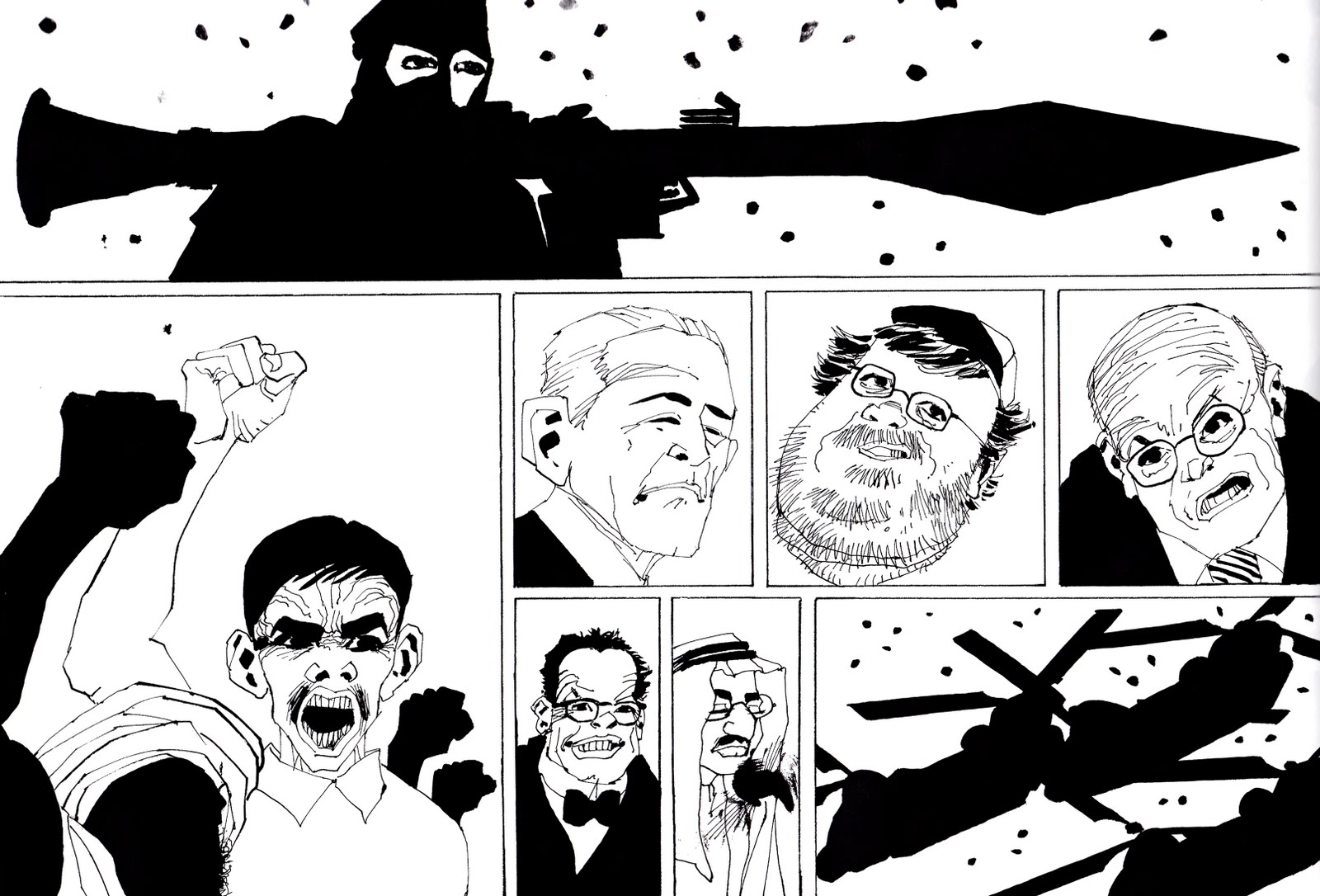
Frank Miller's response to 9/11 was finally released this week. Originally conceived as a Batman tale, but repurposed to involve a generic Batman-like vigilante (the "Fixer") after DC nixed the ultra-violent spree of bigotry, hate, and inappropriate sex, the end result is still unmistakably Batman, albeit the Batman of Frank Miller.

Reviews so far have focused (perhaps unsurprisingly) on the objectionable political content. Muslims are portrayed without subtlety as evil terrorists; the heroes are devoid of character except for their righteous indignation and glee in slaughtering terrorists.

But "content," whether it be plot, character development, or political commentary is not the level of which this book was meant to work. Miller himself has described the project as "propaganda," but there is no pretense here to affect the views of the reader, to manipulate him into any particular view.

Rather, Holy Terror is a passionate rant, an explosion of pure emotion onto the page—in some cases, quite literally.

In the aftermath of the first wave.

The comic works on a purely visceral level; as much a cathartic purge for Miller as anything, the reader nevertheless feels the sweep of Miller's rage, even if he can't quite grasp its target. Of course, Miller's targeting Islamic terrorists, also terrorism in general, also (perhaps) something political? Cultural? Some pages filled with caricatures and random evocative images are clearly not narrative, just splatters of Miller's scattered thoughts.

What exactly is this supposed to mean?

Some reviewers have criticized the lack of characterization of the Fixer. Supposedly, since he isn't Batman, we need backstory, characterization, some reason to sympathize. Despite certain deliberately non-Batman moments (the Fixer uses guns, he explicitly says he suffered no childhood tragedy at the hands of crime), the Fixer is unmistakably Batman—not the Batman of lore and continuity, but Miller's Batman. Miller has earned the right to tell stories with that icon, and he clearly does so here, even after discarding the baggage the historical DC Batman has accumulated over the years as part of his mythos.

Miller's Batman was a Batman pushed to the breaking point, turning his frustration at the world into violence. Unabashedly taking justice into his own hands, a vigilante in the purest, truest sense—however ugly such a thing may be. Targeting fascists, he himself was also a fascist. Just the right fascist. This was the message already in Dark Knight Returns, and the Fixer is in many respects the logical extension of this idea.

"Jihad!" . . . "Gesundheit."

In Holy Terror, the climactic terror event, the proxy for 9/11 (after a sequence of nail bombs explode all over the city), occurs when terrorists fly an airplane into a large statue on the city's waterfront. Reviewers have commented on the obvious similarity with the Statue of Liberty, and one even claimed a simplistic liberty-oriented symbolism: "The terrorists somehow scramble fighter jets (several of them) to blow up a thinly veiled Statue of Liberty (because they hate us for our freedom)."

But this interpretation is bizarre. Although it obviously references the Statue of Liberty, Miller's statue is of Blind Justice. And this is no mistake, for liberty is not a virtue in Miller's world. It is not freedom, but justice which reigns supreme in the world of the vigilante, and it is the destruction of justice for which Miller faults the terrorists, not of liberty. Likewise, it is not even the defense of justice which motivates and explains the actions of the Fixer, but rather the realization of justice. It is just that the terrorists die, the consequences of the Fixer's actions to eliminate them and their collaborators beyond their deaths are simply irrelevant.

Oh, you're surprised / offended by this?


Who are we kidding here? How short is your memory?

Ultimately, Holy Terror suffers from many defects. Criticisms of plot and character are not at all misplaced. But the book works at the level of a rant, and it is a rant of beauty and passion. The art is indeed uneven and schizophrenic, but here again, every style has its moment. More importantly, the unevenness of the art strengthens the feeling of raw power. It's as if Miller is blinded by his own emotions, he can't even see straight while caricaturing Obama, or Michael Moore, or whoever those are supposed to be; he can't even put into words his response because it occurs at gut level. There is no reason, no rationality behind the response, just an intense feeling of injustice and a fantasy to respond and correct.

And in this sense, Holy Terror is more honest and true than many responses to 9/11. There's no pretense here, for better or worse. And let's not forget that Miller is still (at least) a profound talent with images. However chaotic the emotions, facile the story, or uneven the storytelling, Miller can still make the jaw drop with his neo-noir blasts of black and blood and light and shadow.

Saturday, May 7, 2011

rip osama bin laden

For some reason, a large number of Americans seem to find the death of Osama bin Laden cathartic. Now, I'm no friend of islamic fundamentalism, and 9/11 has cast a long long shadow over my life and thoughts, but I have a hard time feeling anything other than ambivalence about Osama's demise.

For one thing, glee at the death of someone else, no matter how "evil," seems in poor taste. More significant, however, is the mistake of thinking Osama was the enemy, or the ultimate cause of 9/11.

9/11 was caused by ideas—the radical fundamentalist muslim idea that the murder of non-believers is permitted + the terrorist's central idea that creation of fear in one's enemy is a means of bringing about political change. If I'm going to feel some kind of catharsis about 9/11, if I'm going to feel "we did it!" or "at last!" or "victory!", then it's only going to occur when I see evidence we've done something to combat these ideas. Are there fewer people today who hate the US? Who think that violence against citizens of the US is both permitted and righteous? Who believe that the suppression of alternate belief systems is both permitted and righteous? If there's evidence to this effect, then I haven't seen it.

With respect to the death of bin Laden itself, the source of my ambivalence is uncertainty about the effect of his death, and the manner in which it was achieved, on the propagation of these dangerous ideas. Whatever guidance (financial, conceptual, or spiritual) bin Laden gave to al Qaeda and related terrorist elements, the fact of the matter is that terrorist acts require hardly any resources at all. Bombs can be built in the kitchen from household chemicals. The most important commodity for terrorism is willingness. If the (manner of the) death of bin Laden creates a greater willingness in potential terrorists to carry out violent acts / sacrifice their personal wellbeing in the name of islam, then it is not a victory, but a mark of increased danger for the American people.

Of course, I already think the real dangers of terrorist attacks are overblown—I'm not advocating public fear here or (heaven forbid!) increased security measures of any kind. The point is that this is a question we should be asking ourselves. If your glee at the death of bin Laden is simple revenge fulfillment, fine, I sympathize. But if you think it has somehow reduced the terrorist threat, lessened the influence of radical islamic ideas, or made America safer, then you presume to a far greater insight into the psychology of the muslim world than I do.

Wednesday, December 8, 2010

real terrorism

Are Julian Assange and wikileaks "terrorists" as some US commentators have claimed?

I'll reserve judgment on that point. But insofar as "terrorism" includes the use of intimidation and the interruption of normal civilized procedures in order to force one's opponents into following some particular course of action, the response by the US government and, especially, various credit card companies seems to exemplify that attitude.

Issuing an interpol warrant for Assange because his condom broke is patently ludicrous. But downright offensive is the recent decision by Visa and Mastercard to block donations to wikileaks. Of course, the claim that using Visa or Mastercard to donate to wikileaks contravenes the user agreement, in particular, the stipulation that funds not be used for illegal purposes, is completely spurious. Wikileaks has not be convicted of violating any international law—treating them as otherwise constitutes a clear violation of the "innocent until proven guilty" principle (not the first time from either the US government or its cronies - one of the very points revealed in wikileaks leaks).

Although the link for credit card donations on the wikileaks page doesn't currently function, donations can presently be made through xipwire. Donate today, or else you may lose control over how you spend your money entirely.

Wednesday, November 24, 2010

thoughts on andrew loeb

[Spoilers, but given how long and complex Cryptonomicon is, they shouldn't diminish future reading enjoyment.]

One of the most enigmatic characters in Neal Stephenson's Cryptonomicon is Andrew Loeb. The character pops up only occasionally throughout the sprawling epic narrative, always in connection with some extremely negative experience of the main characters. Unlike our heroes, we are never given access to the inner workings of Andrew Loeb, his motivations are never explained, and they are just as puzzling to the reader as they are to the primary characters in Stephenson's novel.

The interesting thing about Andrew Loeb is that he's not a self-interested, money-grubbing crook (like, for instance, my ex-landlords), although his actions do often take on this appearance. He sues Randy Waterhouse for the rights to software he's written (with the justification that the idea behind the software was based on Loeb's own research into the diet of hunter-gatherer societies). Many years later, he sues Randy's company at the instigation of high-powered corporate badguy "The Dentist." This frivolous law suit jeopardizes the benevolent, future-holocaust-preventing plans of our heroes. Finally, Loeb appears again in the novel's final scenes, sneaking through the jungle and shooting arrows at our protagonists as they attempt to recover stolen WWII Japanese gold.

Randy . . . looks upstream to see that a man is standing in the water about a dozen feet away from them. The man has a shaved head that is sunburned as red as a three-ball. He's wearing what used to be a decent enough business suit, which has practically become one with the jungle now: it is impregnated with red mud, which has made it so heavy that it pulls itself all out of shape as he totters to a standing position. . . . When he gets fully upright, Randy can see that his right leg terminates just below the knee, although the bare tibia and fibula stick out for a few inches. The bones are scorched and splintered. Andrew Loeb has fashioned a tourniquet from sticks and a hundred-dollar silk necktie that Randy's pretty sure he has seen in the windows of airport duty-free shops. This has throttled back the flow of blood from the end of his leg to a rate comparable to what you would see coming out a Mr. Coffee during its brew cycle. Once Andy has gotten himself fully upright, he smiles brightly and begins to move towards Randy . . . In his free hand he is carrying a great big knife: Bowie-sized, but with all of the extra spikes, saw blades, blood grooves, and other features that go into a really top-of-the-line fighting and survival knife. (892)


There are many different "evil" characters in Cryptonomicon, but Loeb's evil is qualitatively different from the rest. Loeb's motive is righteous indignation: he is convinced beyond a shadow of a doubt that his cause is just. And it is this very conviction that twists his actions towards evil.

Of course, Loeb is also a nutjob, but he is not a simple psychopath. It is Loeb's misguided sense of righteous indignation that drives his pathology, to allow him to do evil with the conviction that it is good.

Painted first as a luddite, Randy is surprised to discover that Loeb has an active internet presence. This turns out to be as a militant in favor of new ideology based on the concept of a hive mind: we are all one, there is no distinction between you and me. Of course, such a view can only aid and abet his rabid sense of self-righteousness. No longer is it only for his sake that he must act (sue, shoot arrows, whatever), but for all of us, because we are all one and our true morality is that of Andrew Loeb.

Certain features of Loeb are clearly modeled on the Unabomber, but in these post-9/11 times (the book was published in 1999), he takes on a much scarier cast by analogy with muslim extremists.

Just like Loeb, the scariest muslim extremist is the paradoxical fanatic. On the one hand, he purports to be absolutely convinced in a pre-medieval cultural system and moral code; not only that it is right for himself, but for all of us. On the other hand, in order to exercise this self-righteousness, he must embrace the technology of his enemies; technology only made possible by the very value system (Western individualistic capitalism and religious tolerance) he seeks to destroy.

Both Loeb and the fundamentalist terrorist allow their righteous indignation to eclipse their own value systems. They embrace the tools of their enemies precisely so they can end those enemies. Such an "ethos" is inherently self-contradictory. It can never survive in a vacuum, but depends upon defining itself in contrast to the other. Without an object of hate, an object against which the self-righteousness can be directed, there's nothing there, no constant moral or social core upon which to rest a peaceful life.

Of course, from the standpoint of those of us who just want to get on with our friggin lives (because we do have a value system that can support and motivate performing acts without them being directed in hatred against another), the scariest thing about Andrew Loeb is that the inherent paradoxical nature of his character precludes the very possibility of rational discourse. There is no reasoning with a terrorist who already embraces contradiction. This is because reason is founded upon the avoidance of contradictions. Once one embraces them, anything follows. No argument can sway, one has simply opted out of rational discourse.

This realization allows Randy and his compatriots to kill Andrew Loeb with clear consciences: a true them or us moment had been reached. And the same reasoning applies to the fanatical muslim extremist who embraces equivalent contradictions.

So, perhaps just this is the boundary of religious tolerance, the line in the sand to draw at the end of modern relativism: your way of life, your religion, your value system can be as radically different from mine as you like. And it deserves my tolerance. But once your value system ceases to remain coherent on its own terms, once it ceases to be a value system for you and becomes just a blanket "justification" of actions against me, then it really is us or them: me or you.

Monday, November 8, 2010

this is slave training

Even the NY Times is agreeing with Alex Jones? These truly must be end times.

Friday, April 23, 2010

south park solidarity

Any self respecting government refuses to bow to terrorist threats. If they allow terrorists to determine policy through the threat (or even the implementation) of cowardly violence against innocents, then that government is no longer autonomous—if others control your behavior through violence, you are a slave.

However, if the citizens and private organizations of a community themselves succumb to terrorist threats, the situation is no better than if the government itself had. For what is the government but the collective will of the individuals that comprise the state?

Comedy Central recently succumbed to terrorist threats and edited the 201st episode (season 14, ep. 6) of the TV show South Park. This episode depicted a number of religious figures and celebrities in humorous situations. One such religious figure was Muhammad, who was envied by all other celebrities precisely because he had the power of not being ridiculed. (Muhammad himself is depicted as an associate of the other religious figures who don't give a damn about such nonsense, as is fitting of a religious figure.) It ended, as all South Park episodes do, with a moral message. Comedy Central blacked out all appearances of Muhammad, bleeped out his name whenever it was uttered, and bleeped out the ending moral message, which "was about intimidation and fear," and "didn't mention Muhammad at all."

It is embarrassing that we live in a country were private businesses don't feel free to allow expression without fear of terrorist reprisal.

It is cowardly of Comedy Central to submit to terrorist threats (and vague, insubstantial ones at that) rather than stand by their content providers.

But it is scandalous and offensive that a moral message emphasizing the dangers of intimidation and the importance of resisting terrorist-imposed fear was also censored in response to nebulous terrorist threats.

Shame, shame Comedy Central you spineless Quisling, you patsy of the enemies of freedom, you embarrassment to free-thinking, liberal-minded citizens of the world. You enemy of morality. You servant of evil, oppression, and fascism!

Tuesday, February 2, 2010

ironwolf

Howard Chaykin circa 1974: "Ironwolf" serialized in Weird Worlds.

Lord Ironwolf is a noble turned terrorist who'd rather destroy his homeworld's rarest treasure than allow it to be used by the empress's hegemony (and does).

In this early work, Chakyin's trademark use of onomatopoeic visuals and cinematic breadth is already on display. Of particular note are the slow motion sequences: close analyses of violent action.

three: the holy trinity: face cards: triangles: separation of powers: pyramids: UFOs: more than two less than four: french hens: persistence of vision