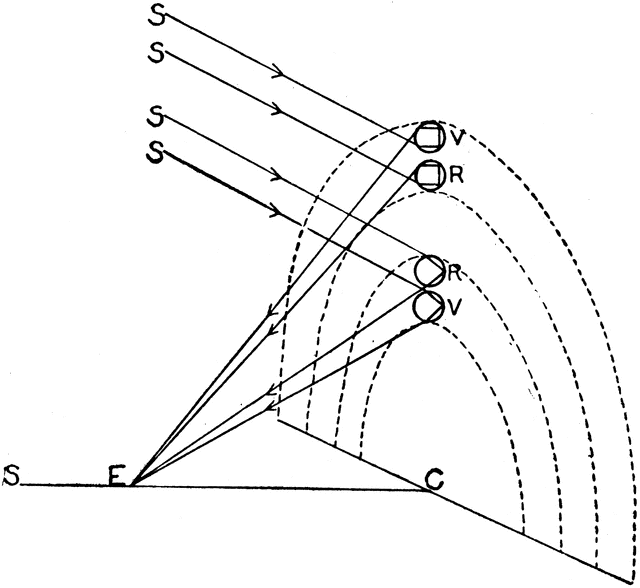
We all (should) know that rainbows are actually circular, although due to the angle at which we typically see them, and their enormous size, we rarely see the entire circle. Usually, just a fragment, a curved portion of a circle is visible.
[nota bene: one way to tell if an artist's illustration of a rainbow is taken from his imagination or "drawn from life" is to examine the angle of curvature. If the curvature of the rainbow is different from that of a segment of a circle, it's evidence that the rainbow is part of the artist's fantasy (or poor memory) and not an observed occurrence.]
My one prior (especially vivid) experience with a circular rainbow was on the Argentinian side of the Iguaçu Falls. The path for viewing the falls included a platform which allowed you to walk out over the basin of a particularly nice fall midway along it's height. Looking directly down into the spray of the water recoiling from its fall, with the sun high in the sky, a perfectly circular rainbow was visible below me in the spray.
Recently, however, I witnessed a circular rainbow in a new form. Flying over the British Isles, starting to come in low for our landing, but still above the intermittently thick (also low) cloud cover, I noticed a circular rainbow tracking our progress below us in the clouds. Against the background of the cloud, the rainbow looked quite tiny, bobbing up and down with each ripple in the cloud's surface.
Of course, the "movement" of the rainbow was really the movement of my perspective. The early morning sun was essentially behind me, shining along my line of sight (c.f. the midday sun shining behind me along my line of sight as I looked down into the spray of the Argentinian fall). Presumably, it was the water vapor of the clouds themselves (?) creating the appropriate refractive effect to send the rays of light back to me at slightly different angles for each wavelength.
As gaps in the clouds appeared, the rainbow would disappear, only to reemerge, apparently projected again against the clouds surface when they returned. I soon noticed the shadow of the plane—also tracking our progress and in my line of sight, of course—visible in the center of the rainbow's circle, approximately the same length as the rainbow's diameter.
Of course, the airplane's shadow didn't disappear during gaps in the cloud cover, but simply transferred itself to the surface of the earth. This fluctuation in the shadow's position nicely illustrated the phenomenon of size-distance invariance.
Since the respective positions of the sun, the plane, and me all stayed relatively fixed, and only the distance of the background against which the plane's shadow was projected changed, the shadow occupied the same visual angle on my retina in both positions. Yet, the plane's shadow on the ground appeared enormous compared to the tiny shadow within the circle of the traveling rainbow. This is because I perceived it as being more distant (since the ground appeared more distant than the surface of the crowd). Same visual angle, but greater distance means the "object" is larger (cover the head of your friend across the room with your thumb—same visual angle, but you perceive the thumb as small and the head as large), hence the changing size of the shadow.
The whole thing was rather magnificent.

