Showing posts with label cinema. Show all posts

Wednesday, April 24, 2013

koffka on comics

In discussing our ability to perceive emotions through the actions of others, Koffka (1935) references Mickey Mouse, alluding most likely to the animated films, but also obliquely perhaps the ability of comic strips to convey emotion:

The best examples for our argument are perhaps certain trick films after the pattern of Michey Mouse, for here there is objectively neither motion nor emotion, but a mere sequence of strange drawings. But this sequence gives rise to objects in the behavioral world of the observers which move, and are agile or clumsy, exuberant or dejected, and so forth. The merit of this example lies in the fact that here all these characters are only in the behavioral objects and entirely absent in the geographical ones. The "meanings" which those forms and motions possess for us are therefore most clearly aspects or results of the psychophysical organizations produced by the stimuli.

~ Kurt Koffka (1935) Principles of Gestalt Psychology

Monday, December 3, 2012

bmx bandits

End credits: "Ready to Fly" by The Papers

(My first bike was a Diamondback)

Monday, October 1, 2012

darkness, light

The first film I ever saw by Jan Švankmajer—shown as part of a late night, public access TV program from Rice University in the early 90s which showcased avant garde animation.

Wednesday, September 19, 2012

Friday, August 3, 2012

the evolving language of film

Film is a means of communication—I assemble a set of images and sounds; you view them and interpret them as significant.  As such, we can consider film as something like a language, a system of rules which allow us to communicate complex ideas.

The "language" of film bears much similarity to the grammatical rules which govern natural language, yet it also exhibits some striking dissimilarities.  In particular, the language of film is evolving at a tremendous rate, and this fact has interesting consequences for how we understand the history of cinema.

Some Similarities.

Natural language is governed by syntactic rules, rules about how its primitive elements combine in order to create meaning. In the language of film, there are many similar rules, although just as in poetry, syntactic rules can be broken in ways which enhance rather than detract from meaning.

For example, consider the 180° rule—this rule states that when editing a scene, all shots should stay on one side of an imaginary line drawn through the middle of the action. In the case of a conversation between two people, the line is typically drawn through the center of their two heads. The scene is then created out of three shots: 1. an establishing shot from the distance including both speakers; 2. a shot over the right shoulder of the lefthand speaker at the right one; 3. a shot over the left shoulder of the righthand speaker at the left one. Shots 2 and 3 show each speaker in close up, but from a vantage on the same side of the imaginary line as the establishing shot.

Just as in a line of poetry, the rules of word order can be violated in order to create rhythmic or rhyming effects, the 180° rule can be violated in order to create disorienting effects, or in order to preserve some especially interesting performance or angle. Likewise, a moving camera can "violate" the rule in a more organic manner, changing the orientation of the audience's perspective in real time.

Also as in the case of poetry, however, rule violation presupposes a savvy audience. A director who decides to violate the 180° rule succeeds in his aesthetic choice only if the audience can follow along, and interpret the spatial arrangement of the action despite it being presented in a more complex manner.

Some Dissimilarities.

And this brings us to some dissimilarities with natural language. It is a fundamental tenet of contemporary linguistics that all natural languages are equally expressive. Of course, a newly discovered aboriginal tribe in the jungles of Papua New Guinea will most likely not have a word for "microwave" (say)—but they can always stipulate a new one. Where their language will be equally expressively powerful is in its syntactic structures. There is no arrangement of stuff which can be described in one language but not in another. In this sense, all natural languages are equal.

Not so the languages of cinema! The language of film has evolved over its short history in ways which have increased its expressive power.

Consider, for example, a camera motion which fluidly crosses the imaginary line of the 180° rule. Such a camera motion was not technically possible in the early days of film, when cameras were enormous and fixed in place. The addition of a new technical possibility expands the language of film syntactically. This is not like adding the word "micorwave" to the aboriginal lexicon, it's like handing them a new grammatical structure, one which can express ideas which could never before be voiced!

But it is not just the technical possibilities which have evolved, so also the expectations and "savvy" of the audience. Long gone are the days of an audience so naïve they could not be expected to distinguish moving image from reality. Today's audience has been educated by the fast cutting of MTV and the shaky cameras and jumpcuts of "reality" television. Along with a more sophisticated palette for expression on the side of the filmmaker goes a more sophisticated means of interpretation on the side of the audience.

Why should the language of film be so different from natural language in this regard? A simple answer is just time. While natural languages (even those of the isolated aboriginal variety) have evolved for tens of thousands of years, the language of cinema has been around a mere 120. Furthermore, this past century has witnessed the most dramatic simultaneous technological and cultural change of any period in human history, and film is right there in the thick of it, evolving at an exponential rate with human culture itself.

A Moral / The Future.

A moral here for the history of cinema is one of apples and oranges. Comparing the films of the 1920s with those of the 1990s is arguably more difficult than comparing Tang court poetry with e. e. cummings. In the latter case there are merely vast cultural divides, but in the former the issue of technological possibility—expressive power—looms large as well.

Will the language of film stop evolving? Will it reach a fixed state? When will film see its first Shakespeare, its first Goethe, its Da Vinci or Michelangelo? Who knows, but the most likely answers are: not anytime soon.

Thursday, May 17, 2012

contempt vs. love: versus

Can love survive contempt?

Or, perhaps, does love depend on contempt?

Andrzej Żuławski's (1975) L'important c'est d'aimer ("The Most Important Thing is To Love", we'll call it "Love" for short) can be read as a commentary on and response to Jean-Luc Godard's (1963) Le mépris ("Contempt")—a commentary which holds up a funhouse mirror to Godard's film and inverts all its basic themes.

Although L'important c'est d'aimer is clearly a commentary on many French films, its special relationship to Contempt is signaled early on by its strikingly similar use of music. Not only are the scores of both films by the same composer, Georges Delerue, but the themes are strikingly similar, and used in very similar ways, i.e. sharply inserted over relatively mundane scenes between long stretches of unscored dialogue.

[Much as Cannibal Holocaust's use of a score by Jacopetti and Prosperi's composer Riz Ortolani signals it as a commentary on their documentary style.]

Additionally, there are further thematic overlaps: both films are stories of infidelity, in the entertainment world (theater; film), with a bizarre commentary on a famous earlier work thematically interwoven (Contempt: The Odyssey; Love: Richard III).

And both movies are about the relationship between love and contempt.

But the relationship between love and contempt is strangely reversed in the two movies.

In Contempt, a young(ish) writer allows / encourages his young and beautiful wife (Brigitte Bardot!) to spend time unchaperoned with his potential employer, the producer (Jack Palance!) of an exploitation film version of The Odyssey directed by Fritz Lang (Fritz Lang!). When he refuses to acknowledge he's done something morally suspect, Bardot describes herself as feeling only "contempt" toward him. Although it is never revealed what happened between Bardot and Palance during the initial incident, she eventually leaves her husband for Palance, her love having evaporated due to her contempt.

The critical scene, in which the writer encourages his wife into the potential for infidelity.

So: for Godard, contempt is the antithesis of love.

re: The Odyssey, Palance pushes on the writer his personal interpretation of Homer's epic, namely that Ulysses is in fact reluctant to return home and deliberately prolongs his voyage because he no longer loves his wife.

In L'important c'est d'aimer a young photographer / admirer becomes enthralled with an "aging" (well, thirty) actress. Her husband allows them unchaperoned situations together, wherein she makes sexual advances, but the photographer never takes advantage of them. Her husband at one point confronts the photographer, saying he's offended the man won't even fuck his wife, and that he "needs a reprieve" from his 6 years of waking up next to her.

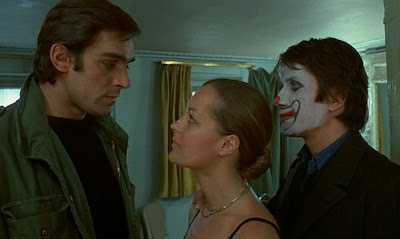
Upon overhearing the romantic conversation between his wife and the photographer, the husband literally puts on clown makeup before confronting them, and inviting the photographer to dinner.

In a crucial late scene, the actress and her husband meet at a cafe of personal significance in the history of their relationship. He says that she feels only pity for him and that this manifests as contempt. He tells her that despite his desire for a reprieve, he loves her, at which point she yells in tears that "I don't even know what that means." Throughout, there is implication that, despite his buffoonery, her husband has somehow supported her through emotionally difficult times, prevented from slipping into a career of prostitution, etc.

Later, the husband commits suicide, and finally the photographer commits to a physical relationship with the actress. In the final scene, the photographer is beaten violently by gangsters whom he owes money. The actress arrives at their home, discovering him beaten, bloody, and helpless on the floor, runs to embrace him, sobbing "I love you."

re: Richard III, as the famous scene between Richard and Lady Anne is rehearsed in the play within a film in Love, the director of the play asks the actress's actual husband to lay in the coffin while she speaks her lines. Later, the scene is recreated when her husband indeed lies dead and she seeks comfort in the "murderer" of her husband, the photographer.

Ian McKellen and Kristin Scott Thomas in a classic version of this scene from 1995.

"Was ever woman in this humor wooed? Was ever woman in this humor won!"

The topsy-turvy recreation of the Richard III deathbed wooing scene, in which the photographer asks why the husband killed himself, before being beaten, and then kissed, by the actress.

So, in both films, the woman feels contempt for her husband—in Contempt, this is why she leaves, in Love, this is why he leaves.

Godard's is a conservative view of marriage—the man fails to assert his protection / sexual ownership of his wife, consequently, she leaves him for one more forceful.

Żuławski's is a bizarre looking-glass version of the control relationship in marriage: by perceiving her man as weak, the actress gains strength herself, but correspondingly drives him to suicide. She replaces him with another whom, only once she sees in him a similarly pathetic and powerless position, is she able to assert that she loves. Here, pity breeds contempt breeds (for her) love. A position which kills her husband and traps the photographer into a twisted, self-sacrificial role.

Inverted also is what we see. In Godard's film, we never see the moments where indiscretion is possible, and this ambiguity is essential in order to understand the emotional tension between Bardot and her husband.

In Żuławski's film, we see all the chances for potential infidelity in excruciating detail, and also the failure of any consummation.

But this decision is crucially tied to the inversion of the message. For Godard's heroine, it is her husband's attitude which offends her; her actions are irrelevant for that dynamic. For Żuławski's heroine, it is her own behavior towards the men around her that drives their madness. This corruptive influence is all the more interesting precisely because her character is so compelling and sympathetic. What is unseen here are not the incidents of the current love triangle, but the 6 years of marriage prior to these events, defining these characters, but elided from what we, initiates into their surface but not their secrets (as is the photographer), are directly able to witness.

Żuławski shows Godard up as a fake progressive. The supposed cynicism of Contempt is unmasked as traditionalism against the strangely believable inverted chaos of Love's romantic entanglements. True cynicism is revealed in the movie's very title, an implicit answer to an implicit question.

Le mépris?

Non, L'important c'est d'aimer.


P.S.

L'important c'est d'aimer also happens to feature the greatest Klaus Kinski scene of all time. Kinski plays the actor protraying Richard III, and it's indeed a pleasure to see him deliver the "now" speech, and seduce Anne over her husband's coffin. On opening night, though, at a restaurant afterwards, the players receive the evening edition of the paper and read a scathing review. This is Kinski's reaction:

(The two lines essential to understand this scene. First, Kinski accuses the passing drunks of "touching his coat," asserting "Since I am a well-bred homosexual, I care a lot about my things." After the beating, he remarks to the women, "If you're as vulgar as he, it will be perfect." Before leaving with them. Awe inspiring.)

Saturday, May 12, 2012

bad lieutenant: versus

The relationship between Abel Ferrara's (1992) Bad Lieutenant and Werner Herzog's (2009) Bad Lieutenant: Port of Call New Orleans is highly ambiguous. Reportedly, Ferrara hated the 2009 version, and Herzog didn't even see the original.

As far as I can tell, Port of Call is the first produced feature script by a TV writer, although on imdb they've credited all four writers of the original as well, perhaps because there are so many plot / thematic similarities between the two movies.

Both "bad lieutenants" (i) take drugs; (ii) gamble; (iii) abuse their authority to obtain drugs; (iv) abuse their authority to obtain sexual favors; but also (v) do actually care about their role as homicide investigators and pursue it vigorously.

Additionally, the arc of both movies is similar, with a traumatic event haunting the lieutenant (original: massive gambling debt accruing as the Mets come from behind to beat the Dodgers in a seven game series; Port of Call: constant pain due to an injury suffered during Hurricane Katrina) as he relentlessly investigates a horrendous case (original: Nun raped in a church by young hoodlums; Port of Call: immigrant family slaughtered by drug lords).

Both films bear the distinctive stylistic marks of their respective directors.

But one can see the origins of Ferrara's hatred of the Herzog not-really-a-sequel, perhaps, in the radically different messages of the two films.

Ferrara's is a complex Catholic passion play. In his quest to solve the rape / desecration case, the lieutenant (re)discovers the significance of sacrifice and forgiveness in the attitude of the nun, who refuses to identifier her assailants because she has already forgiven them. Ultimately, promising her the justice she wants, he discovers their identities, but helps them escape, thereby sacrificing his own life in the process. Redemption through sacrifice and forgiveness.

Herzog's version is completely stripped of religious imagery or significance. Instead we see the images of violent nature and chaotic forces common in so many other Herzog films. Where Ferrara's lieutenant sees images of Christ's suffering on the cross, Herzog's sees phantom iguanas and break-dancing Japanese. Where Ferrara's lieutenant "solves" his case by helping the criminals escape and sacrificing his own life, Herzog's sees a bizarre twist in fortune, and arrests his criminals on phony evidence, though preventing his partner from slaughtering them on the spot, instead trusting the due process of law to see right. There is redemption here, but redemption through a combination of chance, diligence, and assistance from others.

So, Ferrara's message is quintessentially Catholic, while Herzog's is resolutely humanistic. Unsurprising, perhaps, given Ferrara's Catholic upbringing and Herzog's chaotic youth during World War II.

Wednesday, April 25, 2012

ode to torture porn

"Torture porn" is a derogatory term recently in vogue for describing the genre of cinema which is exploitative and centers upon the graphic depiction of torture.

What is the appeal of such a genre? Why would anyone, presumably with enjoyment, watch a movie valued (solely) for its depiction of torture?

The answer is the human condition.

Torture porn is rightly compared to porn, for both are instance of "exploitation" cinema, where exploitation here is characterized by a value measured solely in the depiction of some particular subject, not by more abstract measures of cinematic value (story, acting, dialog, etc.).

Shakespeare, for example, is the sheer antithesis of "exploitation" in this sense precisely because, even during his most ludicrous comedies, bloody tragedies, or ass-kissing historical plays, the value of the play (as we cherish it today) does not depend upon the depiction of farcical situations / violence / fawning political commentary, but upon the clever dialog and subtle characterization.

Porn is the most famous exploitation genre, exploiting the act of sex, but it depends no less single-mindedly upon the mere depiction of sex than, say, martial arts movies depend upon the depiction of a certain style of violence, westerns on a certain setting and aesthetic, horror upon creation of a certain type of suspense, etc.

So, "torture porn" is justly named, it is indeed the valuing of the mere depiction of violent acts of torture against other human beings over and above plot / dialog / characterization / production value / etc.

But why? What is the appeal, and, empirically, given its existence as a profitable genre for decades, there is appeal, of torture porn? What drives people to watch it? In what sense do they enjoy it?

Here, a compelling answer is found in the culture which is perhaps the greatest consumer (and producer) of torture porn: Japan. The 1976 film Shogun's Sadism, also called The Joy of Torture 2: Oxen Split Torturing begins with this quote:

'The weak become the victim of the strong,' is a rule of mankind. Cruelties have been inflicted everywhere since time began.

How true this observation is! But let us be careful. Let us not be swayed by utopian dreams of an equal society, where every individual is equivalent in power to another and there are no "weak" and "strong." Politically, such a situation has never been realized. Even attempts (one thinks: Soviet Union, North Korea, China, Cuba) to establish a communal society universally fail. No matter what, strong and weak separate, communities organize themselves into a hierarchy on the basis of power.

This is no less true at smaller or larger scales. Just as nations economically bully each other into engaging in particular international policies, so smaller groups (a class in elementary school, a university department, a band, a pair of lovers) inevitably establish structures of power, control, and thus hierarchy. Of course, at smaller scales, there is much more room for give and take, for the possibility of some kind of equivalence, even if it is only represented by a regular alteration in the relative positions of power.

As Baudelaire observed:

[L]ove is very like a torture or a surgical operation. But this idea can still be more bitterly expressed. Even though a pair of lovers may be deeply devoted, full of mutual desires, one of them will always be calmer, or less obsessed, than the other. He or she must be the surgeon or torturer; the other the patient or victim.

No accident that he characterized love as a "[d]readful game, in which one of the players must lose his or her self-government," for "government" in every sense is a position of power, of control. And the inherently hierarchical structure of human interactions necessitates the abandonment of (self-)government.

Torture is the purest realization of that aspect of love which mirrors the general structure of society as a whole; the necessary preconditions of the organized interaction amongst those who, without interaction, would otherwise be equals.

So, the existence of torture is the fundamental precondition for human society.

(Surely, this has already been remarked upon by Bataille?)

But this does not explain the appeal of "torture porn" the movie genre. For if it is indeed a precondition of social interaction, if it does indeed permeate every moment of our human existence, what pleasure then is to be derived from the single-minded fictional depiction of torture? What pleasure derived from the externalization, the graphical and physiological depiction, of an inherently internal and counterfactual social dynamic. "Torture porn" makes that which exists at the level of possibility, of control, of what can be achieved, visible, visceral, and ineluctable.

Here, the crucial answer is to be found in the attitude of the cinema goer to his or her positions within the many overlapping social hierarchies in which she / he participates.

Those who are resigned to their position or those who are satisfied with it, will not enjoy "torture porn."

"Torture porn" is a genre of the disenfranchised, the dissatisfied, those who desire a change (a radical, violent change) in social position. Furthermore, this desire for change must be intimately intertwined with some (subconscious? / conscious?) understanding of their social standing and a realization (even mere gut "grasping") of the relationship between their state of mind (happiness, or lack thereof, etc.) and their position within this social hierarchy.

And here, the ostensibly value-neutral flavor of this essay must end.

For, desiring a position of greater power precisely so that one might wield that power is surely morally reprehensible. To wish to dominate in principle, so one might also dominate in practice, is to succumb to sadism, evil, and the very corrupting influences of power which motivate the drive towards equality as a regulative ideal in the first place.

So, yes, the lover of torture porn may be evil.

(A Japanese example, one picked at random amongst many: Tsutomu Miyazaki.)

But this is not the only human drive which might motivate an "enjoyment" of "torture porn." And this precisely is the point, and why "torture porn" as a derogatory term is indeed unjustified, why the assumption that those who do "enjoy" it are necessarily monsters is, in fact, the true position of evil. The position assumed by the sadist, the torturer, the pervert.

For the desire to be a part of hierarchical change may be motivated not by inherent cruelty, but by pain, victimization, the realization that the lack of power one holds over one's life, that impotence, is an unfair and undesirable state. One might identify in torture porn not with the torturer, but the torturee. And not out of some misplaced (masochistic) sexual dynamic, but out of pure empathy.

For we all are tortured in this life, and to see a graphic analogical depiction of the that very whimsical "torture" to which we are every moment subject may have a profound power of catharsis.

Thus, so-called "torture porn" may be a positive force for healing, for self-realization, for release, understanding, acceptance, but also a constructive release of tension.

And this is why the critiques of Mel Gibson's Passion as mere "torture porn" are so ignorant and woefully misplaced. For this is indeed the role that the story of the passion of Christ as a mythology has always played—a role of catharsis for those subjugated by the (inevitable and universal) power structure of society. This is precisely why the story achieved the religious power it has, why it continues to be spread amongst oppressed peoples, why we see it as a positive and uplifting story. To focus on the pain of Christ is to focus on the plight of those who are not at the top of the hierarchy, of those who are subjugated, controlled, "tortured" by those with more power. That just is the religious significance of the story. That just is why it is a story about love and faith and healing and positive change for a better world.

Christ without the sacrifice would be Marx, Stalin, Castro—he would be the faux-torturee, a mere fascist, a dictator, a torturer.

What about those who identify with the torturer because they long for social change? Those who wish not to be subjugated, not merely so they can subjugate (as the serial killer or the sociopath), but so they can reap justice. Should we condone—must we condemn—those who revel in the possibility of retribution when they watch "torture porn"?

This is in many respects the predicament of Alex, who identifies with the Romans when hearing bible stories, yet whose apparently nihilistic rampages are clearly motivated to some large degree by his position of soci-economic impotence within society. His sadism amongst his droogs is precisely mirrored by the ease with which the larger political structure of society bends and controls him. Howsoevermuch we may revile him for his deeds, what are we to think of the casual manner in which his very personhood is violated against his will by grander, and indifferent social forces. Alex's cruelty is a faint reflection of that cruelty and control to which he is potentially subject by his very place within society and to which he becomes actually subject in the conceit of A Clockwork Orange.

Insofar as retribution may be just, the viewer of torture porn may identify with the torturer in clear conscience. And you, who are resigned, complicit, or who yourself inflict that social torture which he thereby escapes, have no moral standing for criticism.

But insofar as the justice of retribution depends upon a constructive drive towards the regulative ideal of equality, the identification with torturer should be tempered by an identification with torturee, for otherwise the pendulum will swing too far, the desire to supplant the inherent injustice of the hierarchical structure of social interactions will be replaced by a mere lust to occupy the domineering position in such interactions, and the altrustic communistic ideal will curdle into fascism, as it always has in political practice.

"Torture porn" then is indeed technically porn. But it is also religious text, a potential for catharsis and for the recognition of and rebellion against that very order of society which itself ensures, institutes, and institutionalizes torture.

Sunday, February 19, 2012

Thursday, February 9, 2012

heathers

On rewatching Heathers recently, I was shocked / dismayed / pleasantly surprised (?) that I seemed to have missed (?) / forgotten (?) the monocle. In the words of Ferris, the monocle is "so choice."

Sunday, November 20, 2011

footnote to a reference

In Terry Gilliam's Twelve Monkeys (1995) there is a scene where Bruce Willis awakes in the present (our future) after his second time traveling episode (to 1995) to find the "scientists" who sent him on his way arranged around his bed singing "Blueberry Hill." The scene is referred to by Wikipedia as "a direct homage to the 'Dry Bones' scene in Dennis Potter's The Singing Detective."

Scientists sing to Willis.

It strikes me, however, that the scene is more of an homage to Dennis Potter himself (and his work as a whole), a talent who, upon reflection, shares much with Gilliam and surely must have influenced him greatly.

Dennis Potter wrote a sequence of powerful teleplays for British TV, including Pennies from Heaven, Brimstone and Treacle, The Singing Detective, Lipstick on Your Collar, and Karaoke. He had a cunning knack for combining powerful drama (often drawn from his own personal experience) with fantasy and humor. A trademark of all his teleplays is the thorough integration of music into the story, often involving lip-synced routines during hallucinatory or revelatory experiences by the primary characters.


In the Wikipedia referenced "Dry Bones" scene, doctors are indeed arranged around a patient (a standin for Potter himself, who also suffered from a debilitating skin condition) experiencing a combination of nervous breakdown and dissociation from reality, much as in the Twelve Monkeys scene. In Twelve Monkeys, however, the song being sung is not "Dem Bones," but "Blueberry Hill," a song referenced by Potter in the later teledrama Lipstick on Your Collar (where the Fats Domino version is lipsunc by a young, debuting Ewan McGregor):


[For completeness' sake, it's worth noting that in Gilliam's scene the doctors actually sing (relatively poorly) the classic tune, while in both Potter scenes, the songs are lipsunc.]

A crucial datum here is the dates: Potter died in 1994, succumbing to pancreatic cancer a mere 9 days after his wife's death from breast cancer. Given that Twelve Monkeys appeared in 1995, it was likely being shot or written in 1994 when Gilliam must have heard of Potter's demise. What better way to memorialize him than to insert scenes (not just the singing itself, but the setup when Willis hears "Blueberry Hill" in 1995) combining Potter's love of period music with his realization of that love through musical numbers?

Most telling of all, however, are the thematic continuities between Gilliam's work and Potter's. Of course, Gilliam is a mature artist in his own right, with a very distinctive style, so it would be a mistake to attribute too much of his voice to the influence of Potter. Nevertheless, there are telling similarities—at the very least, Gilliam must see himself as participating in the same tradition, realizing the same spirit, as Potter.

Most compelling to me is the example of Brazil (1985). Brazil, in both theme and execution, is strikingly Potter-like. Gilliam combined personal experiences of a harrowing sort (albeit with bureaucracy rather than disease) with a passionate love story, all transported to a fantastical setting. He unifies these diverse thematic elements with a compelling musical subtext, in this case the song "Brazil":


Brazil is notable for a) the smooth juxtaposition of humor and horror, and b) the rich inner life of the main character, as illustrated through numerous surreal episodes indicating his dreams / fantasies / imaginations. Both elements are found in all Potter teleplays, yet are (unfortunately) rare in cinema as a whole.

Of course, only Gilliam himself could tell how great Potter's influence, and the exact significance of the telling scene in Twelve Monkeys—what seems clear is that the scene serves as an homage to more of Potter than just The Singing Detective, and that the deep thematic coincidence in the works of Gilliam and Potter deserves further scrutiny.

Tuesday, October 4, 2011

not

If you've seen the ad for the new Transformers movie on dvd, you might be asking yourself what ignorant idiot could possibly describe it as "the best action movie ever." Apparently no one. Liars.

Monday, June 6, 2011

on inception

Lucid dreams can sometimes produce the illusion of reality. A Nightmare on Elm Street (1984), for example, was based on a series of articles about young men who experienced terrifying dreams, refused to go to sleep, and later died in their sleep. For them, the terror of their dreams became so real it killed them.

More recently, Inception (2010) used a similar setup (entering the dreams of others) in order to explore the possibility of an idea being implanted in one's subconsciousness while one was asleep and dreaming (the "inception" of the title). In this more focused investigation, it is argued that dreams within dreams ("deeper levels" of dreaming) provide access to deeper levels of the subconscious, and thus facilitate the planting of a new idea.

I've experienced dreams within dreams on several occasions, and there are two features of the phenomenon which Inception certainly got right: 1. the dream within a dream tends to be more surreal / bizarre / "unrealistic"; 2. after waking from it, there is a feeling of reality, one has just woken up, which may then be subverted by further dream weirdness. This is a feature which has been exploited to great effect in a variety of places in popular culture—not just the aforementioned movies, but also genre pieces such as Neil Gaiman's Sandman (e.g. the character trapped in an eternal sequence of nightmare wakings at the end of issue #1).

But there is a weakness with the dream within dream approach to inception—if one does succeed in convincing oneself that one is awake, then whatever is remembered of the levels of dreaming that had occurred is judged a part of dream land.

Compare this with another phenomenon: dreaming about dreams. Suppose for example, one experiences a rather vivid and lucid dream, which closely adheres to an actual event, changing it in relatively small respects. Then suppose, as sometime happens, after brief awakening, one dreams a more surreal and bizarre dream, a subconscious response to the incidents of the earlier one. When one awakes from the second dream, the certainty that one is in fact awake, and that the preceding events were in fact dreamed, is not evidence against the reality of the previous dream (in the way it is when dreams are embedded). In fact, if the second dream was sufficiently vivid, one can become uncertain about whether the incidents which inspired it were produced by reality or a previous dream . . .

Of course, the effect depends crucially on the plausibility of the first dream. The essential point here is just that arbitrarily plausible embedded dreams receive an evidential refutation which arbitrarily plausible dream-inspiring dreams do not. Suggestion for a future inception technique?

Wednesday, May 25, 2011

memories . . .

Memories were meant to fade . . . they're designed that way for a reason.

~ Strange Days (1995)

Sunday, May 22, 2011

bilal's evolving revolutionary

Finale to The Hunting Party (1983)

Enki Bilal is a comic book illustrator/writer and movie writer/director who was born in Yugoslavia in 1951 and emigrated to France at the age of nine.

Bilal's art and vision are magnificent, both on the page, and on celluloid, but a theme which runs throughout all his major works (including those he only illustrated) is the role of the revolutionary. It's natural to assume that the atmosphere in post WWII Belgrade influenced this trend, plus perhaps, and more personally, his own family's history (apparently, his father was once a tailer to Tito; more importantly, his father was Bosnian, while his mother was Czechoslovakian).

For whatever reason, the revolutionary, the anti-establishment anti-hero, has featured as a leading character in all of Bilal's significant works. The role of this character, however, has evolved over the course of Bilal's career: from hopeful successes, to temporary victories, to pessimistic post-heroes, doomed to relive the consequences of their revolution(ary act), without even the recollection of its motivation.

Anti-gravity town making trouble for authority figures in The Cruise of Lost Souls (1975)

The initial phase is clearly visible in Bilal's work with Pierre Christin, who wrote a trilogy of fanciful political commentaries for him, eventually collected as Townscapes. In each of these three stories, a mysterious stranger interferes in some bizarre way to bring about a surreal political statement, heartily endorsed by local disaffected townspeople. In the first two, Cruise of Lost Souls (1975) and The Ship of Stone (1976), there's a strong sense that change is achieved, if only on the local level.

With the third book in the trilogy, however, The Town that Didn't Exist (1977), a strange foreboding appears. The local factory has been shut down, and the workers protest for better wages and benefits. When the old man who owns the corporation dies, his crippled daughter inherits his wealth and his business. She employs her financial resources and political influence to construct a utopian dream city for the inhabitants of the old town—here they may do as they please without worries about finances or security.

Here, the progressive social goals of the trilogy's enigmatic protagonist appear to have been achieved, yet when he leaves the new city, he is joined by several of the former factory workers, one of whom proclaims "that town doesn't really exist." Interpretations abound here—is utopian success a dream? Is philanthropic behavior such as that of the daughter in principle impossible in capitalist society? Or is it the workers who are blind to what they can achieve, who doubt the validity of the Marxist utopia that could await them if only they found the right resources? The text is silent on interpretation, but the darkness and ambiguity of the ending casts a long shadow over the earlier stories.

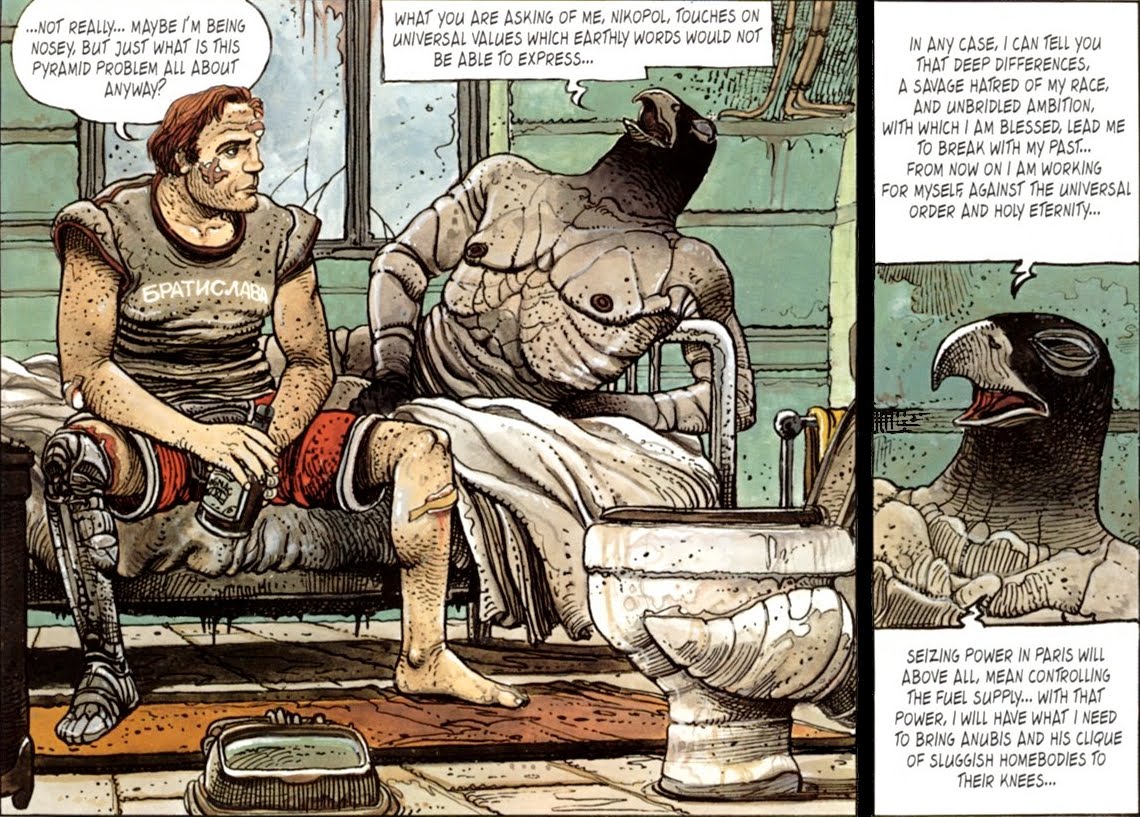
Horus chats with Nikopol about godly matters.

Perhaps the most optimistic of Bilal's revolutionary stories can be found in the first volume of the Nikopol trilogy, his most famous work. The titular character, Alcide Nikopol, unlike almost any other Bilal hero, is not actually a full-fledged revolutionary, but a mere deserter, sentenced to life-long hibernation. When incompetence awakes him on a corrupt future earth, he is partnered with Horus, a "revolutionary" figure in the pantheon of Egyptian gods. Horus wields his supernatural powers to place Nikopol in political power over the Paris of 2023. A fascist dictatorship is overthrown, Nikopol is free to implement the progressive policies of his choice, and Horus abandons control of him for more godly matters.

Yet, despite La Foire aux immortels (1980) evincing the first instance of widespread political control and change achieved by a revolutionary (albeit a reluctant one), the atmosphere at end is far from optimistic. Nikopol goes mad and his son (who looks like his twin due to Nikopol's period of government mandated suspended animation) is placed in control in his stead. By volume 3, Froid Équateur (1982), just a few years later, we learn that Nikopol's son's progressive government has been overthrown by the fascists: revolution is short lived. And Horus himself, the revolutionary deity, is on the run throughout the entire trilogy, defeated multiple times by his peers. (Though in the final scenes of volume 3, after the Egyptian gods' pyramid-shaped space ship is accidentally destroyed, Horus' leadership is finally welcomed.)

Horus takes control.

During the decade+ it took to complete the Nikopol trilogy, Bilal collaborated again with Pierre Christin on The Black Order Brigade (1979) and The Hunting Party (1983) (collected as The Chaos Effect). Both books paint a much bleaker picture of the revolutionary than Bilal's earlier work with Christin. The Black Order Brigade, in particular, features the first introduction of a common theme in Bilal: the ex-revolutionary. Here, a group of passionate progressives who had fought in the Spanish civil war, reconvene in their old age to combat the titular "black order brigade," a fascist death squad with whom they had had many skirmishes during their glory days.

The "Black Order Brigade" assassinate a leftist politician before the eyes of our "heroes."

Unlike in the war itself, however, when the young progressives had been suffused with idealism and optimism, they find their new quest quickly sours. The pains of old age, the indifference of the general public, and the futility of correctly conveying their message (in the media, they are treated as terrorists, no different from their fascist counterparts) drag down their spirits and motivation. By the end, they succeed in eradicating the black order brigade, but at the cost of all lives but that of the original organizer and narrator. In the final panels, as he relates the conclusion to their saga, he mournfully proclaims "I . . . got all my friends killed for a reason I can't even really remember anymore."

Ironically, the mysterious traveling revolutionary of the earlier Bilal / Christin collaborations makes a brief appearance as an accomplice—sympathetic to the cause, but largely outside the specific plans and woes of our heroes. This war is not for him, and its Pyrrhic "victory" hints at the impossibility of radical social change. Idealists cannot succeed, and, more importantly, they cannot even maintain their idealism should they try.

Bilal appears to be obsessed with cobalt blue . . .

In The Black Brigade, ex-revolutionaries choose to resume their activities, with ambiguous, arguably disastrous, consequences. In Bilal's films, e.g. Tykho Moon (1996) and Immortal (2004), the lead characters are ex-revolutionaries forced back into revolutionary action. In the case of Tykho Moon, the title character is a former revolutionary suffering from complete amnesia. He recalls neither his revolutionary acts, nor why he engaged in them.

Nevertheless, Tykho is forced into transgressive acts anew by the bizarre lunar dictatorship of the Mac Bee family, whose degenerative disease demands organ transplants, and with whose genetic code Tykho is uniquely compatible. Although Tykho eventually succeeds in executing the last of the Mac Bees and escapes the moon with his love interest (herself a hired killer and former employee of the dictatorship), the motive is never revolutionary change, but mere survival. An actual revolutionary (from earth) who assists him is spurned on the the topic of political idealism and dies in the violence of the finale.

Another Bilal obsession: the Eiffel Tower, not only appearing here on the Mac Bee's moon (alongside some other faux monuments and the rocket launching pad), but also in Immortal's NYC!

In Tykho Moon, we see the personal details of life (survival, love, the chance to dance with a beautiful woman) overwhelm revolutionary priorities. One who simply lusts for a life to himself is forced into revolutionary action, and consequently, his actions are drained of idealism, and suffused instead with necessity. Obligation, unavoidable and personal. At the end, although the dictators are overthrown, we are given no promises about the future political situation on the moon. Our heroes do not aim at reform, merely survival.

Similar themes can be found in Immortal, Bilal's screen adaptation of his own Nikopol trilogy. Unlike the Nikopol of the comics (and much like Tykho Moon), the Nikopol of Immortal is an ex-revolutionary. He has been sentenced to 30 years imprisonment in suspended animation on a floating prison. A freak accident sets him free prematurely. The fascist NYC in which he finds himself is ruled by a "medical dictatorship," but his name survives as a rallying cry (the "spirit of Nikopol") amongst those who oppose the regime.

Jill learns about humans (since she's quickly becoming one) in the "Human Museum."

Just as in the books, a large chunk of plot is devoted to Horus' attempt to impregnate Jill via Nikopol. Just as in Tykho Moon, the very personal goals of love and survival motivate Nikopol's actions, and the execution of fascist dictators and general social upheaval which take place along the way are largely incidental. In Immortal, not only the whims of the fascist elite, but also those of the gods force Nikopol and Jill into a sequence of bizarre situations. No longer is the blame for the revolutionary's actions foisted solely upon the state—here fate, or at least its proxy, are equally, if not greater to blame.

Horus and Nikopol's first meeting—Nikopol's reciting Baudelaire (as usual), but how does Horus know the words?

So, while Bilal has continued to focus on the revolutionary as character throughout his career, we see a gradual evolution from the revolutionary as active instigator of social change to the revolutionary as accidental instigator of social change. The reluctant revolutionary is at first forced into this position by the very authority figures he eventually destabilizes, though later, it is fate, or forces beyond his control generally rather than merely political forces which motivate his actions.

Amir's lover tries to turn him on to their next mercenary assignment.

The most recent chapter in Bilal's evolving depiction of revolutionaries is the so-called "Hatzfeld tetralogy." Unfortunately, only the first two volumes are available in English (as The Beast Trilogy: Chapters 1&2), so the overall trajectory of the work is as yet unclear to those of us who are linguistically limited. So far, many similarities emerge with Bilal's earlier works. Just as in the Nikopol trilogy, the backstory is elaborate, involving various layers of authoritarianism and fascism. Religious dictatorships, terrorist NGOs, evil policemen, bizarre alien intrusions, all make an appearance, buffeting the world our characters inhabit.

Unlike in the works discussed above, the protagonists are not (yet) explicitly terrorists themselves, but rather mercenaries, scientists, and prodigies for hire to the various competing forces which shape their world. No longer is there an "evil" authoritarian power force, and a "progressive" outsider revolutionary, but rather a sequence of authoritarian forces with various religious and political motivations. There is no "right" side for the would be mercenary to choose, and given the trajectory of alienation from idealism we've seen in Bilal's previous works, it's perhaps unsurprising that the protagonists here do not begin with an ideology, but rather a skill set of interest to ideologues.

The Hatzfeld tetralogy draws more explicitly on Bilal's Yugoslavian heritage than any of his previous works. The story centers around a trio of "Yugoslavians" of different ethnic and religious backgrounds. Their origin is retold by the protagonist Nike Hatzfeld, who's gift is a complete photographic memory (contrast with Tykho's amnesia!) which dates back to his very first days of life, when he and Amir and Leyla (the other two Yugoslavian orphans) lie next to each other in a Sarajevo hospital as it is ripped apart by violence.

Shades of Nazi death camps (and the terror camps of the Yugoslav wars are mentioned explicitly in Nike's recollections).

The chaos of the future world inhabited by Nike, Amir, and Leyla somehow mirrors the violence of the dissolution of Yugoslavia. Bilal focuses on individuals buffeted by larger political and religious forces beyond their control. The revolutionary becomes an employee when there is no right or wrong, but only conflict.

[If we're lucky, the re-emergence of Humanoids as a North American publishing force will result in new editions of the Nikopol trilogy (now, sadly out of print and exorbitantly priced) and the Hatzfeld tetralogy.]

Friday, May 20, 2011

cannes = nazi

What does it mean to sympathize with an ideology? Does saying you sympathize with it qualify you as sympathizing with it?

(Even if you are obviously joking, say? And you say you are joking, and you are referencing the particular details of your personal life (say, you are raised by a Jewish father and told by your mother on her deathbed that he was not in fact your biological father)? And you explicitly reject those features of the ideology which are damning (e.g. WWII) and emphasize your sympathy for the human being (no matter how "evil") who inspired the ideology rather than the ideology itself?)

Or is sympathizing with an ideology acting upon it, say by demonstrating fascist ideology through the censure and control of the speech and acts of individuals? Who here is acting "contrary to the ideals of humanity and generosity"? Who here is the real nazi?